Monday, 25 April 2016

Whitianga and The Mercury Bay Museum - Work trip, fun trip

Bean Rock Lighthouse, Auckland
What better way to spend a glorious autumn day than to travel from Auckland to Coromandel by ferry?  I work as a tour guide at the National Maritime Museum of New Zealand and  was off on a work trip with a group of colleagues.  We had been invited as guests of the Mercury Bay Museum in Whitianga on the Coromandel Peninsula. Skimming across a flat azure sea under clear sunny skies, past verdant islands and contented fisherman lolling about on their boats the two hour trip sped by in a flash.  At Coromandel we were met by a bus which ferried us over the high ranges to the beautiful township of Whitianga.  It had been many years since I had been there camping with my family and I am pleased to say that although it has grown somewhat the town still retains its quiet, laid back charm.


A pristine boat skims the pristine sea off Waiheke Island


From the top of the Coromandel Ranges looking back towards Coromandel township
There's no doubt about it, small towns sure know how to make visitors welcome.  The enthusiastic volunteers and trustees of the Museum greeted us with afternoon tea, wine and loads of good conversation. Housed in a former dairy factory, the museum is impressive and although it covers many aspects of New Zealand life there was more than enough maritime history and information to keep us engrossed. Over two days we were treated to lectures on coastal trading, Captain Cook and the wreck of The Buffalo, which occurred just off the town's long golden sand beach now named Buffalo Beach. The ship still lies off shore and can be seen from the air, at times, lying in its sandy grave. I found all the lectures absorbing and valuable, it's always satisfying to learn new things and increase your knowledge.


Mercury Bay Museum

Excellent exhibits and good conversation


Mural on the exterior of the museum
This visit exceeded my expectations.  Our hosts were warm, hospitable and fun to be with.  Their information and knowledge helped broaden ours.  We have invited them to join us at our museum and look forward to hosting them sometime soon.
Nature paints a beautiful picture in Whitianga
As I have mentioned before, I love getting up early in the morning and going for a walk, especially when on a holiday.  It was no exception in Whitianga. I wandered along the beach and all around the sleepy, early morning town.  Mist was swirling over the hills and the sun was just poking its head up behind them.  Fishing boats at anchor made perfect reflections in the dark mirror-like water.  Tiny colonial cottages with their curtains drawn sat in rose festooned gardens and the smell of coffee filtered out across the bay. I felt pangs of nostalgia remembering the happy times my husband and I  had shared here when our children were small.  Sadly, the camping ground we stayed at now houses luxury apartments.
Finally I found the lovely Harbour House Cafe on the waterfront  where I sipped coffee, ate breakfast and read the morning paper. I felt perfectly at peace with the world.
The Whitianga boat harbour


Picturesque colonial cottage right in the heart of town
Then, all too soon, it was back to Auckland by bus.  My visit to Whitianga has whetted my appetite to return, only next time it will be for longer as there is so much to see around the area that a short visit cannot do it justice.  Our visit this time was for a purpose and one that was fulfilled many times over.  A big thank you to the trustees and staff of Mercury Bay Museum.  You have a fine museum, a real credit to you.

Tuesday, 12 April 2016

Japan Day, Auckland - and an easy Japanese salad recipe


The supreme elegance of the Tea Ceremony
Sometimes it is way easier to go to something alone and  Japan Day in Auckland last weekend was one of those times.  Not because it wouldn't have been fun to share it with someone but because the crowds were huge and tight and it would've been hard to stay together.  I suspected it would be a bit of a squash but  as a Japanophile I had been hanging out for a Japan fix for a while so couldn't resist the urge to go.

Japan Day has grown bigger and more popular over the last few years and is one of the reasons I love living in New Zealand's biggest city.  I am a sucker for cultural festivals and with its multicultural  population Auckland now has its fair share.  Regular readers of this blog will know that I have a particular love for Japan and Japanese culture so on Japan Day I was in my happy place.


 Hinamatsuri dolls -set up as for  a religious festival

All things Japanese were on display, from ikebana, bonsai and calligraphy to kempo martial art, traditional dance and the strange, unique Japanese street fashions  of Lolita and Gothic Lolita.

Visitors could try their hand at calligraphy, play Japanese board games, dress up in a kimono or sample the potent Japanese beer (8% alcohol).

There was a stage for J-pop performances and another stage for traditional dance and song.  The tiny tots from Auckland's Japanese kindergarten were little scene stealers

Food stalls offered sushi, okonomiyaki (one of my favourite light meals) sashimi, teriyaki, green tea ice cream and a myriad of other taste delights.  I wandered around with a big smile on my face snapping photos here and there and pretending I was on holiday in Japan. The steady drizzle didn't dampen my spirits nor, anyone else's, it seemed.
Traditional dance

Bonsai


My nephew, a black belt in Kempo
Pounding the rice for rice cakes
Lolita Japanese street fashion


And here, as promised, is the easy recipe:

JAPANESE PICKLED CUCUMBER

1 cucumber
3 tablespoons of rice vinegar
1 tablespoon of water
2 teaspoons sugar
1/2 teaspoon of salt
1/2 to 1 teaspoon of grated fresh ginger
toasted sesame seeds

Peel and half the cucumber lengthwise.  Scoop out the seeds and slice the cucumber thinly. Mix all other ingredients together except for the sesame seeds.  Pour over the cucumber, stir and leave to marinate for an hour or two before eating.  Sprinkle the sesame seeds over to serve.
This is a great side dish, condiment or palate cleanser.  It is also superb served in sandwiches with roast beef.   It takes about 5 minutes to prepare and will keep for a day or two in the fridge.


Monday, 28 March 2016

Guide to souvenir shopping - Do you really need another sarong?

We've all done it - been enraptured by the vibrant clothing at an exotic destination and bought the shirt/hat/sarong/skirt, whatever, thinking that this will be just the thing to wear for summer barbecues back home. Problem is, we get back from holiday and find it simply doesn't look right in our home setting so it ends up cluttering a drawer. At some stage it gets hauled out for a fancy dress party.
                                                                                             One of my mistakes
 Wrong colour, wrong size, never worn


I have traveled a lot over the years and have learnt from painful experience what are good and what are bad souvenirs.  Here are a few of my suggestions to make your souvenir shopping worthwhile.

1. Think carefully about whether the item will be useful or whether is it just a novelty.  If it is a novelty don't buy it.  Novelties are five minute wonders and end up in a drawer until eventually thrown away.

2. On that note: Don't buy key rings, shot glasses, hula skirts, sombreros, clogs, mini Eiffel towers or similar, or anything vulgar or funny-the jokes wear off pretty quickly.
           
3. If you want to buy something to remember the trip by try to choose just one good quality item, within your budget, rather than a lot of small gimmicky items
                                                                                                  
4. Don't leave your souvenir shopping until the airport.  You will be pushed for time, flustered and could make rash purchases.  Airports are homogenous and there is not much of a choice anyway. Buying friends and family chocolates says "I forgot about you until the airport and then I panicked"

5.  Ask yourself if it is a popular item at your holiday spot. For example is everyone wearing a batik shirt?  Don't be swayed, you will probably never wear it back home

6. Beware of touts.  Good quality shops don't need them

7. Don't buy books on places you visit.  Unless it is something you are really interested in take it from me you are unlikely to look at them again.  I am referring to the  colourful, and usually expensive, guide books to palaces, castles, cathedrals etc. Having said that, one of my favourite books, a memoir, The Lady and the Monk, by Pico Iyer, is a souvenir from Japan

8. Start a collection of something useful.  I collected one Christmas tree decoration from every country I visited  until my tree had enough decorations.  Every Christmas it is fun to unpack them  and remember where they were bought. I have also collected coffee mugs, usually in blue and white, from various places I have visited.
Some of the mugs in my collection these are from Italy, Turkey, Japan, England and Wales

HERE ARE SOME OF MY FAVOURITE SOUVENIRS:


A child's antique kimono bought in a small village in Japan


A wooden tobacco knife crafted by a whittler from Tennessee

Displayed here with a Celtic cross from Dublin, a Japanese painting and a New Zealand sculpture


Miniature pottery houses from both the Cinque Terre and Copenhagen


A white linen and lace tablecloth and napkins from China
A tiny pewter pepper mill from Turkey
A collection of scarves from many different places
My diaries - I write extensive diaries on my travels and enjoy re-reading then from time to time.  It is amazing what you forget,
Photographs
A few of my sarongs.
CDs of ethnic music - ethnic music is one of my interests 

.....and, yes, several sarongs.  Sarongs are useful and good gifts since they take up no room in your bag. I always pack one when I travel.  They can be used as beach wraps, table cloths, picnic mats, summer bed covers, even towels in an emergency.  It's just that you don't need too many of them!


Enjoy your holidays.  Don't spend time hunting for souvenirs and gifts, that's just wasting precious time when you could be doing other things. Send postcards if you want to remember folks back home.  It's a dying practice but I, for one, love to get postcards from exotic destinations.  Buy one good quality souvenir for yourself if you want and buy scarves, bookmarks (can't have too many, they always go missing!), sarongs, coffee mugs, place mats, linen for friends.  For male friends some duty free wine or spirits always goes down well.

HAPPY TRAVELS!


Monday, 7 March 2016

Swakopmund, Namibia

More tales from my African adventure of 2010:
The Oryx - the national animal of Namibia

We travel through spectacular scenery on the way to Swakopmund, spotting exotic animals along the way including the solitary and handsome oryx, the national animal of Namibia. We stop for photographs at The Tropic of Capricorn and pass through vast mountain ranges of striated rock.  Way out in the middle of nowhere in a lonely and desolate canyon a couple of German men hid out during the second world war to avoid internment by the British.  I have no idea how they survived in this arid and hostile landscape but survive they did and wrote of their experiences in a book called The Sheltering Desert, a fascinating account of endurance and self sufficiency. Until I arrived in Namibia I had no idea that it was so scenically stunning, so vast, so empty.
It was in this area the Germans hid out - wild and desolate


Thousands of flamingos at Walvis Bay
We stop at Walvis Bay to admire the large flamingo colony and the lavish homes along the foreshore before  a long, tedious trip through a flat golden desert, the wind spinning the sand  into whirls. At last we arrive in Swakopmund and our accommodation - a hotel with real beds and showers and...well, you get the picture!  We are delighted and all dive into the showers.  What bliss!


Endless straight roads through swirling sand
In the afternoon we are taken for a tour of the shanty town on the outskirts of the city.  Many of the houses are built from cardboard, scraps of iron, plastic and timber but the streets are all tidy and litter free. It is very humbling to see people live this way, however, the government is endeavoring to improve things by constructing small tidy houses on the edge of the shanty town. There is a very long waiting list for one.
The "Township" Swakopmund

We call in at the home of a woman from the Damara tribe.  She is dressed in the rather quaint costume Damara women have adopted, based on 19th century German dress, including a hat shaped like cow horns, in honour of the tribe's love of cattle. It is a cultural requirement that women of the tribe speak in a soft low voice, almost a whisper, so our guide repeats her answers to our questions. She takes us on a tour of her tiny but very neat house and then offers to dress some of us in Damara dress as a surprise for the rest of our group.
With a Damara tribes woman -  We dress in the tribal costume.  I'm far right

 Our next stop is at the home of the Damara chief, a tiny, gracious,wizened old lady of 85. She sits in her living room answering questions interpreted through her nephew, Beadle, while children and grand children saunter backwards and forwards through the house. Beadle is a large, beaming young man with an impressive head of plaits.  We are all transfixed by their unique clicking language.

Proud of his gift of a pencil

As we walk around the township we are greeted  warmly be everyone we pass while children run around us playing tag and rolling around like puppies.  We give them gifts of pencils.  They are so thrilled you would think it was a million dollars and we are quietly ashamed of the affluence of the West. At the local shanty bar we enjoy a refreshing drink and listen to some cool, funky African music as locals come and go. I enjoy watching a loose limbed young man dancing to the beat and could have stayed watching him for hours.  In a small thatched hut beside the bar we are served a traditional meal of cold maize porridge, beans, chicken, spinach and roast caterpillars, yes, roast caterpillars!  I tried them to be polite, but won't again! Finally some children put on a short but enthusiastic dance display for us in a narrow, dusty alleyway.  It has been a brilliant tour, so sobering, so informative, so humbling.  We overcome our feelings of intrusion once we are told that tourism is vital to the township's economy and highly valued by the residents.

There are some good examples of the Namibian Click language on Youtube.


Sunday, 28 February 2016

Kaipara Coast Sculpture Gardens

Regeneration by Murray Swan
Regular readers of my blog will know that I enjoy strolling around sculpture gardens, pondering the art, and soaking up their ambiance and scenery. As far as I'm concerned it is the perfect combination for a day out.  A week ago I took a drive into the country to visit the Kaipara Coast Sculpture Gardens, about an hour's drive from my home. What an unexpected delight.


 Owner, David Bayly, grew up on the land on his family farm. From an early age he developed a deep interested in plants and eventually bought a part of his father's  farm to turn into a very successful plant nursery.  The sculpture gardens were part of his vision and through the determination and sheer hard work of both David and his wife, Geraldine, they now form a sublime and tranquil backdrop for the art exhibitions they have held every year for the last eight years.


The Secret Life of Trees by Denise Marshall

 The one kilometre trail winds through a peaceful, rural valley with constantly changing vistas.  Along the twisting pathways you will find a well maintained vegetable garden and orchard, mown lawns and hydrangea lined paths, groves of pine trees and New Zealand bush reflecting in ponds, the whole coming together harmoniously.  Against this backdrop are the sculptures, 59 in all, carefully picked to suit their specific location.

 I liked the whimsical display of brightly coloured ladders, with amusing quotes written on them, set amongst the orchard, a contribution to the exhibition  from the Bayly's.
Example: Quote from Mae West "She climbed the ladder of success from wrong to wrong"


Hydrangeas by Janette Cervin

As with every sculpture trail some of the art is beautiful, some is challenging and some is more prosaic. It is a good mix. There are plenty of places to picnic and also seating for quiet contemplation.

Taraxacum Forest by Janet and Mario Downes
A recent addition to the gardens is a bush walk created by David and his father, Don, which winds down into a valley past a stream and a waterfall, sadly rather summer dry when I was there, but a lovely walk with excellent views out over the Kaipara Harbour.

The bush walk was carved  using traditional tools - wheelbarrow, shovel and rake
I spent about 2 and a half hours in the gardens, had them completely to myself and loved every minute of my visit. I was on a high for the rest of the day and will look forward to returning next year to see the new exhibition.  One thing to be aware of - 14 of the sculptures are on the long driveway into the gardens.  I nearly missed them and they are worth seeing. There is also a cafe within the plant nursery which was very busy the day I was there.  The current exhibition runs until October. 


Contact:    www.kaiparacoast.co.nz   or   sculpture@kaiparacoast.co.nz

Dragonfly by Bruce Young


Seagulls by Jay Lloyd ( the Kaipara Harbour in the distance)


Monday, 22 February 2016

Auckland's Chinese Lantern Festival

 I bit the bullet on Friday and attended Auckland's lantern festival. My aversion to crowds meant that I have avoided it for the last few years but when I heard it had moved to a much more spacious venue I thought it was worth another visit.


Living in a large multicultural city has great benefits; there are numerous authentic, ethnic restaurants around the city serving delicious food from all corners of the globe and an increasing number of cultural festivals to enjoy. The downside is that there are also large crowds attending those same festivals.


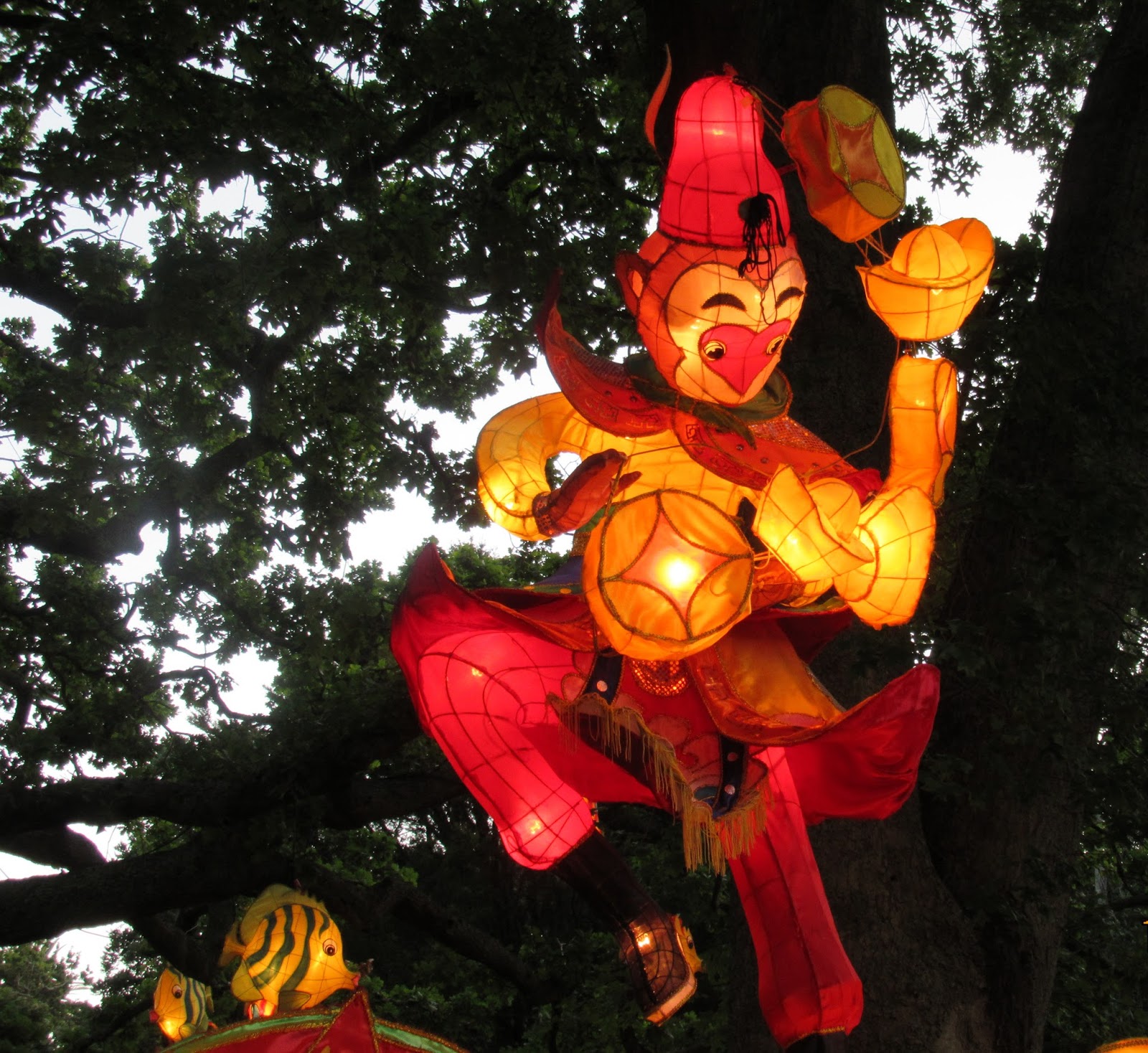
2016 is the year of the Monkey
  Since Aucklanders of Chinese heritage now make up 10% of Auckland's population it is fitting that the Lantern Festival, timed to coincide with Chinese New Year, has become one of New Zealand's most popular festivals.  Held over four days it is a combination of stunning lanterns,specially created in Sichuan, China, which are hung from trees and scattered around the gardens, cultural performances and asian ethnic food stalls.  No wonder it is popular!

I think I played it just right this year.  I arrived early in full daylight.  Found parking very close to the venue, bought my dinner before any queues had formed and enjoyed the slowly developing spectacle as the sun went down and darkness descended. I watched martial arts displays, musical performances and, of course, the lion and dragon dances. Having viewed all the lanterns in their glory I made my way home as the crowds continued to swell to almost impossible proportions.  I felt very content if not slightly smug as I passed the food stalls with queues of 50 or more. Nevertheless the good thing about the new venue, the Auckland Domain, is that there is plenty of space surrounding the festival area to picnic and watch the festivities from a distance, away from the crush, if it gets too much for you.

Here are some of my photos from the night, they don't really do the lanterns justice.


Monday, 15 February 2016

To Cruise or not to Cruise? - that is the question

January 1963 aboard the MV Willem Ruys, England to New Zealand
"Our gang" - I'm on the far right


When I was 14  I traveled by sea from New Zealand to England  with my parents and three of my brothers.  The trip took around 5 weeks and was absolutely wonderful.  All those weeks of freedom, hanging out with other teenagers all day, indulging in heaps of innocent fun, no chores to do, entertainment and meals laid on and our parents relaxed in the knowledge that we were safe and happy.  15 months later we made the return journey and it was just as good.  Stops at exotic ports along the way were an exciting added bonus. They were some of the happiest times of my early life and are etched deeply in my memory.  Curiously I have never felt the urge to go on a cruise again.  Partly, I think, because my late husband suffered terribly from sea sickness and wouldn't entertain the idea, but also because I saw it as an activity for either the elderly or for young and rowdy party animals.  Nevertheless, when my brother rang and invited me to join him, his wife, and a couple of their friends on a very short cruise I jumped at the chance.  4 nights at sea seemed like the perfect tester to see if I liked it or not. So here is my list of the pros and cons of cruising:

THINGS I ENJOYED:
1. Getting up early and walking around the ship when everyone else was still asleep.  Morning is my favourite time of day and having a deck to myself to enjoy amazing sunrises was bliss
Sunrises at sea are spectacular
2. Being mesmerised by the dark navy blue sea, the frothing whitecaps and the ship's wake
3. Sharing meals and company with friends and family. We had a delicious meal at the premium restaurant one evening.
4. No telephone, no internet, no news,  no chores, no cooking = no stress
5. Good quality shows in the theatre
The beautiful, captivating, endless sea
6. Unpacking my suitcase and not having to pack again until I left the ship
7. People watching - an endlessly fascinating pastime
8. Dolphins at sea and tug boats and pilots in port.
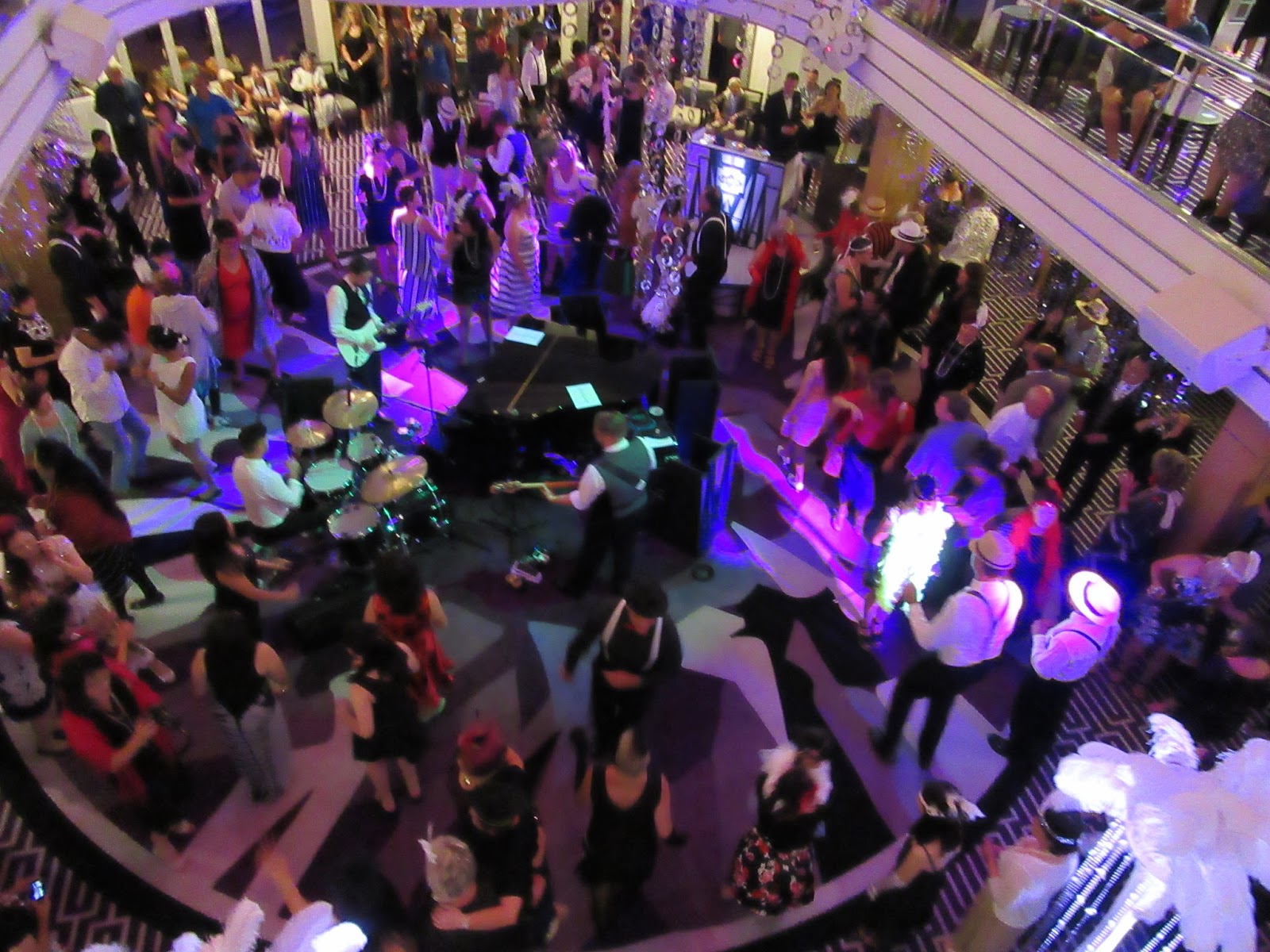
9. The Great Gatsby Party - a theme night on our particular cruise - loads of fun
The Great Gatsby Party - everyone got into the spirit of the night
10. The adults only Oasis bar on the rear deck
11. The gentle almost imperceptible rocking that lulled me to sleep each night
12. The feeling of well being from huge lungs full of fresh sea air

THINGS I DIDN'T ENJOY:
1. Crowds of people
2. Too much noise.  It seemed every time we were settled in a quiet bar for a chat a quiz competition or band started playing. Most of the entertainment in the bars was pretty cheesy. Several times we had to pick up our drinks and move elsewhere for some peace
3.  As above, trying to find a peaceful spot to settle with a book.  I did manage to find somewhere each day but it took some doing
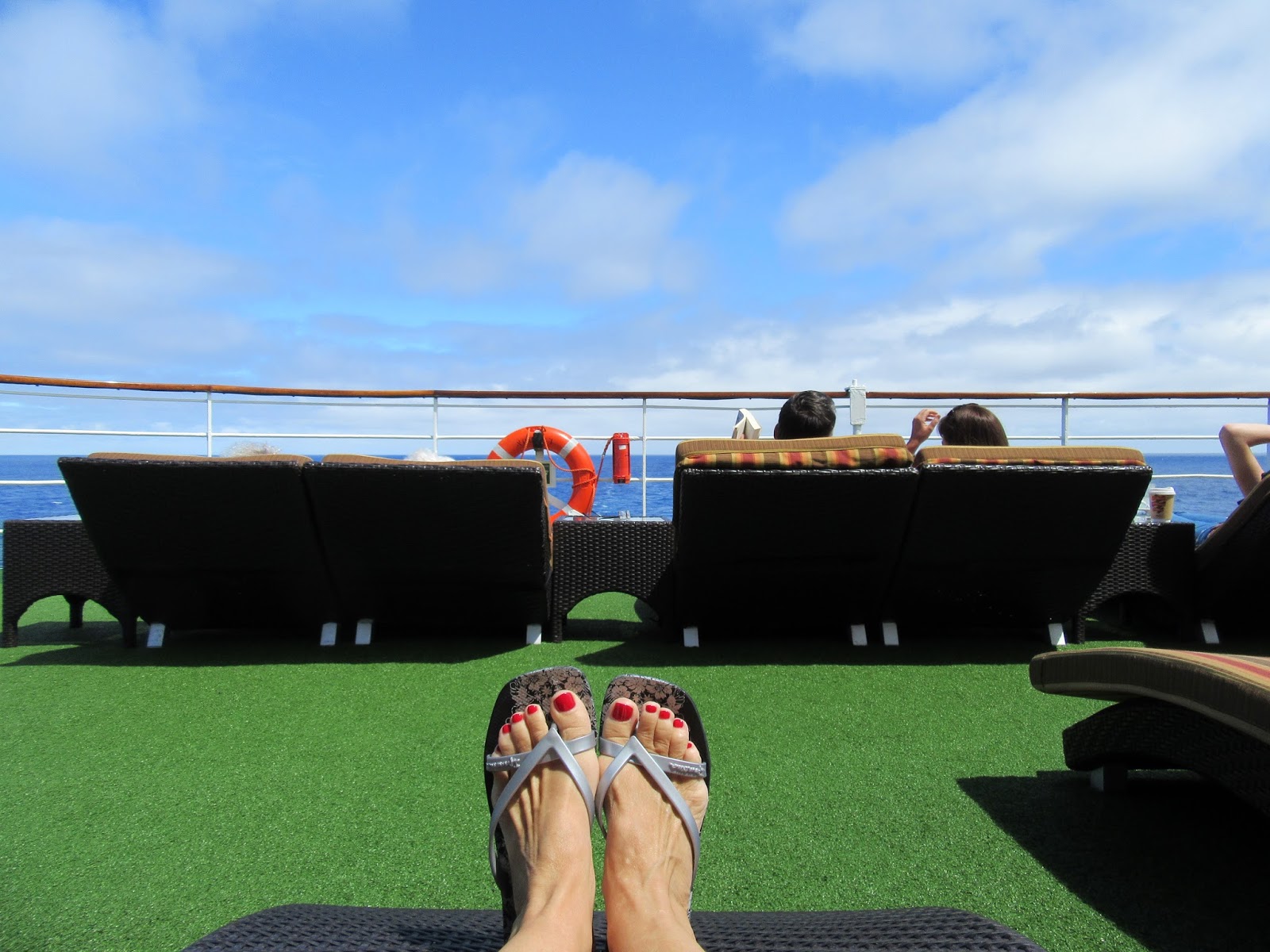
At last!  A quiet place to read
4. The feeling of being trapped aboard
5. The short time in port. It is impossible to get to know a city in a few short hours.  I like to really get to know a place, mix with the locals, eat local food etc.  It didn't matter on this cruise because I had been to the one city we visited many times before but if I was going on a longer cruise I would feel cheated.
6. From my observations over many years I have noticed that prices suddenly go up in shops when a ship is in port and small towns get over run by large numbers coming ashore.  Some passengers like to wear their ship board ID cards proudly around their neck when they come ashore.  Big mistake!  You are advertising yourself as a cruiser and therefore fair game.

There are many grades of cruise ship from pretty basic to 6 star so it is a good idea to do your homework before booking a cruise to see what best suits you.  Some ships cater more to families and the young party set, others cater to the older generation looking for peace and quiet and yet others cater to everybody.

As you can see my "Pro" list is longer than my "Con" list.  Would I go on a cruise again?  Yes, I would, but it would be for the cruise itself, not to see the world. Cruising is a  relaxing, stress free holiday but  to see the world properly and get to know a people, place and culture, requires longer time ashore than a cruise can provide.