Saturday, 27 April 2013

Christchurch - a city with a broken heart but a fighting spirit


Demolition and bulldozers everywhere
In September 2010 Christchurch, New Zealand's second most populous city, was shaken by a magnitude 7.1 eathquake.  Although it was a sizable shake and there was damage to many buildings no one was killed and repairs to affected buildings began in earnest.  Nobody, however, expected 
the second deadly earthquake which occurred in February 2011 killing 185 people, and causing widespread devastation across the city and suburbs. Many of the city's buildings, already weakened by the first earthquake, were unable to withstand a second big shake.  The disaster was the second deadliest in New Zealand's history, after the Hawkes Bay earthquake of 1931 when 256 people were killed.


What was once a thriving city centre
I live in Auckland, in the North Island of New Zealand, and my knowledge of the earthquake came from what I had seen on TV and read in the papers.  We Aucklanders knew it was major and many of us did our bit to assist through donations and support for the people of Christchurch. But TV and newspapers cannot give the full picture so it was with shock and amazement that I saw Christchurch first hand last week.  I simply had no idea how big a disaster had occurred.  Christchurch is a city I had visited often, both for work and to visit friends and family. It was a city I was fond of and where I had favourite places to stay and cafes to frequent.....they are all gone.  The inner city just does not exist anymore. There are a few multi storied buildings still standing but many of them are due for demolition soon.


The beautiful old Theatre Royal (1907)with its facade propped up in the hope that
 it may be saved and a new theatre built behind it

 When I arrived at the new temporary bus station in the centre of the city I was completely disorientated.  There were no landmarks I could recognise and I felt completely lost.  With the help of a charming old man, a long term resident, I eventually found my accommodation, having to walk a long and circuitous route due to blocked off Red Zone areas (too dangerous to enter).


Christchurch Cathedral, the heart of the city. The damage is worse than it looks.
The hotel behind it is due for demolition
A once trendy mall off Cathedral Square now derelict and overgrown
One day I took a specially licensed tour of the Red Zone and just could not fathom how much has been lost.  Christchurch had an iconic Cathedral, the centre point of the city, which is now in ruins and the subject of a fierce debate as to whether it should be restored or demolished.  There is little else left in Cathedral Square, the heart of the city.  All the main shopping streets are gone and vast areas of the city are either bull dozed waste land or buildings in the throes of demolition.  I walked through some suburbs and saw a lot of damage to houses.  At least 100,000 homes were damaged in the quake and it is estimated 10,000 of those will be demolished.  The liquefaction caused by the quake was estimated at 400,000 tons which bubbled up around and invaded homes and had to be laboriously shoveled out. As with many a disaster it brought out the best in people and volunteer groups of students and farmers quickly arrived to offer help.


Sad sign on a damaged shop


Poignant installation art remembering the 185 killed


Christ College , Christchurch
Fortunately some of Christchurch's best loved old stone buildings have survived around the fringe of the inner city.  The much loved Arts Centre is badly damaged but will be restored and Christ College, the more English than English boy's college, suffered relatively minor damage and has been repaired


 The earthquake has taken a huge toll on the health and well being of the local residents.  It is heartening, therefore, to see signs of recovery and clever morale boosting projects popping up around the city.  I was deeply impressed by the resilience of so many and the thought and creativity that has gone into cheering people up in incredibly difficult times.  I strolled past a big corporate event being held in a bulldozed uneven carpark.  Prior to the earthquake it would, no doubt, have been held somewhere swanky and upmarket....but there is nowhere like that left.  Those attending the event seemed to be enjoying themselves.  I guess, for them, this is just how things are at the moment.

Put $2 in the converted washing machine
and dance your cares away - Christchurch
A library for all to use outside someone's house

Furniture made from grass and painted daisies to brighten up the city


The funky and popular container mall
Christchurch's  old, well established, flag ship department store, Ballantynes, is in the heart of the city.  It was damaged in the quake, but not badly, and was quickly restored and renovated. It was the only shop left in the city centre.  Stepping inside it it is as if the earthquake never happened.  It is a beautiful store with a lovely cafe and must be a great boost for the locals. The main shopping street has been completely cleared and in its place is a smart trendy container mall consisting of stacked shipping containers painted in bright cheerful colours which house a number of eateries, shops and even a bank.  It is attractive and fun and although it is a temporary measure it doesn't feel that way.


Signs of recovery - the repaired New Regent Street opened for business late April
It is a strange thing to say but I really enjoyed my time in Christchurch.  I felt sad for the people of the city and
shocked at what I saw but also impressed by the air of positivity and the feeling that life and people are what is important, not bricks and mortar.   A quote I heard at the graduation ceremony I was in Christchurch to attend sums it up well : "The best of things happen if you make the best of things that happen"

Monday, 15 April 2013

Williamstown - Melbourne - Australia

City of Melbourne from the Williamstown ferry
With a few hours to spare before meeting up with family I decided to take a cruise to the town of Williamstown on the outskirts of Melbourne.  Williamstown is advertised as an historic seaport in Hobsons Bay and that sounded just like my cup of tea. The cruise takes about 45 minutes and is, to be frank, a little underwhelming.  After passing through an attractive part of downtown Melbourne it is a long slow journey through typical port industrial areas before finally arriving at the pretty boat harbour and Gem Pier at Williamstown.  The town has had a rich and colourful history from the time it was originally occupied by indigenous Australians of the Kulin nation.  It was first settled by Europeans in 1835 and saw explosive growth during the Victorian gold rush in the 1870s.  It was also the centre of the Victorian Navy and is still home to a boat building dockyard for the Australian navy.


Port of Melbourne tugs lined up ready for action
A fascinating piece of history is the fact that Williamstown was the only part of Australia to play a part in the America civil war by assisting the confederates. The warship, Shenandoah, docked at Williamstown for repairs in 1865 and stayed a month while it was repaired, the crew enjoying all that shore leave had to offer, until it finally sailed again with an illegally recruited crew. This caused huge embarrasment to Great Britain, which had remained neutral during the civil war.  The governor of Victoria refused to arrest the ship which had gone on to sink 25 US merchant ships so the colony of Victoria was seen as being an accomplice to the US south. Great Britain, as a consequence, had to make a large financial reparation to the US government.


Historic buildings, Nelson Place


Stepping off the ferry I found Williamstown to be a sleepy place, a bit scruffy around the edges and still in the throes of turning itself into an historic village.  There is an excellent information centre adjoining the reserve by the pier where you can pick up self guided walking maps and the Customs House (1874), nearby, is a fine building housing a marine themed gift shop and an art gallery. The main streets, Nelson Street and The Strand have some attractive old buildings but it was disappointing to find that they housed nothing more than a couple of non descript shops and some very ordinary eateries.


Timeball dating from 1849


It is important to get a map and to do a walking tour because the gems are well hidden amongst some very tired and run down parts of the town.  The botanical gardens are well worth a look.  Although small they are very pretty.  Walk through the gardens and you come to the lovely golden sand Williamstown beach.  Further around the coast is the rare, fully operational, Timeball Tower. This was invaluable to 19th century ships whose crews were able to set their chronometers by the timeball which dropped at exactly 1pm each day.

I wandered around for a couple of hours, seeking out the historic buildings amongst the industrial and badly run down.  One of the most bizarre things I saw was a pub called The Titanic, complete with a  replica of the ship's superstructure and funnels covering the roof.


Williamstown wasn't quite the marine heritage town I expected.  Devonport, in Auckland, outshines it on that score, however, there are signs that Williamstown is beginning to attract a new type of settler, one who values the rich and extensive history and heritage of the town, as attested by the number of  old cottages being restored.


 As I walked back to the ferry a young teenage girl fell into step with me.  She was lost and asked me the way and we walked together for some time.  She said she had arrived by train from central Melbourne to meet some friends and that her mother had been concerned about her going to Williamstown as it had had a bad reputation in the past.  She told me her mother was just remembering what it was like in her youth when it was a seedy place but that it has improved since then.  She was an absolute delight as she chatted in her disarming way....she made my day.


Wednesday, 3 April 2013

Funky Melbourne

I've just returned from a few days in Melbourne, Australia, and had a great time visiting familiar haunts and hanging out with family.  The main purpose of this trip was to attend a nephew's wedding which was a beautiful, joyous occasion,  however, while there, I took the opportunity to enjoy many of the interesting corners of this lively, bustling, artistic city.

Hosier Lane - the graffiti in this lane is prized and a  real tourist attraction.
  The Movida bar is atmospheric and has a fantastic range of tapas.


Melbourne is a big city, the capital of the state of Victoria it has a population of more than 4 million in mainly low rise housing that sprawls over a vast area nevertheless I spent most of my time in and around the city centre and was never at a loss as to how to fill my day.  Simply wandering the streets is as much fun as anything but the city does have a lot to offer. Here are some of my picks and hints for some of the funky things to see and do in Melbourne City.  I will do further posts looking at different aspects of Melbourne later.

Howey Place
Laneways: I love the Laneways of Melbourne.  These tiny lanes were originally access points and delivery lanes for businesses fronting onto major streets but they have since become destinations in their own right.  Now crammed with cafes and boutiques  many of them have a personality all their own. Some of the coffee shops are tiny and make wonderful coffee They are great places to hang out with a cup and watch the world go by. Hosier Lane absolutely covered in artistic graffiti is a major tourist destination, Hardware Lane, full of restaurants and cafes, has a very european feel to it while Howey Place boasts designer boutiques amongst the cafes.

I also love Block Arcade.  This is not a "lane" but a beautifully elegant arcade with wonderful architecture and home to the very popular Hopetoun Tearooms.


That's me, in white jeans, photographing me on the giant screen
in Federation Square
Federation Square: Right on the banks of the Yarra River, which flows through the heart of Melbourne, the square is  known as "the" meeting place in Melbourne.  This large sloping square is a buzzy, funky place.  It is where festivals are held, I lucked into an International Cultural Festival while I was there. It is also the location of the visitors centre.  It's a bit of a mission to get down the long staircase to it, alright for me but not for the aged or infirm, but it offers very good service  The Art Gallery at Federation Square is an absolute must.  It is a wonderful gallery with constantly evolving exhibitions.  The adjoining Ian Potter Centre is a fantastic place to familiarise yourself with aboriginal culture and art. And after all that just grab a sandwich and sit by the peaceful, gently flowing Yarra for a quiet interlude.  There is also free Wifi in the square.
The National Art Gallery at Federation Square, in front of the Cathedral
 spire on the banks of the Yarra River
An interesting and definitely
"funky" sculpture at the
National Gallery


Street artist, working in pastels, on Swanston Street


Street Artists:  I enjoyed Melbourne's street artists and performers.  There is such a variety of artists doing all sorts of things and they are very good.  Lingering for a few minutes to watch a performance always brought a smile to my face.  The good thing is if you don't like a performer you just keep walking.


Trams: Melbourne has a wonderful tram system. I've included it in my "funky" posting because some of the trams truly are old and funky....but great fun.  They are frequent and fast and get you to most places around the city and inner suburbs. The best thing for tourists is the free tram which circles the city centre in both directions and includes an informative commentary. I made very good use of this on several occasions. The city is beautifully laid out in a grid system so it is very easy to find your way around and never too far to walk from the free tram to your inner city destination.

Monday, 11 March 2013

Fontenay Abbey - Bourgogne - France


One day Mary and I decided to take a drive through  the beautiful Burgundy countryside to visit Fontenay, one of the oldest abbeys in Europe.  There is something about old abbeys that I love.  I think it is the peace, the tranquility, the history and the sense that the ancient stone walls have somehow absorbed centuries of service and prayerful reflection.  Well that is how old abandoned abbeys feel today but it is not how they would have been when they were first founded and flourishing. When it was founded by St Bernard in 1118 it would have been a bustling self contained community of 300 monks living a prayerful, contemplative life but also working hard to produce all the community's needs. The years of back breaking work the monks undertook to drain the marsh in order to build the abbey paid off and today this stunning property lies in a valley surrounded by magnificent trees and gardens.


Inside the vast church


The abbey flourished until the 12th century and became famous for its successful farming practices but it entered a decline when the French monarchy took it upon itself to nominate "commendatory abbots" to lead the abbey.  Later it was ransacked during the 100 years war with England so that by the time of the French revolution there was only a handful of monks remaining. The abbey was sold as a national property in 1790 and for 120 years  was used as a paper mill. In 1906 Edouard Aynard, a banker and art collector, bought the abbey in order to restore it.  He dismantled all remnants of the paper mill and returned it, as much as possible, to its original glory.  It is still owned  by the Aynard family and has been on the Unesco World Heritage list since 1981. It is a beautiful, austere place.

The dormitory
The forge


The church is huge, 66 metres long and 16.7 metres high.  It has long been stripped of all decoration and has a gravel floor but to my mind that makes it all the better. I found looking up to the ceiling or down the length of it in a gloomy half light was quite awe inspiring.  The original dormitory for the monks adjoins the church with direct entry so that the monks could go straight to their prayers first thing in the morning. The romanesque cloisters, (cloisters are always my favourite part of an abbey), are lined with council rooms, a common room and work rooms where manuscripts were painstakingly illuminated. The forge is an impressive building, 53 metres long.  It was here the monks extracted iron ore from rocks quarried near by.  The Fontenay stream which passes the abbey was used to power the tilt hammer and bellows of the forge where the monks produced a wide variety of tools and implements which they sold to surrounding villagers.

I love cloisters
Other buildings include a warming room, the Abbots lodgings, a wayfarers chapel and bakery, the gatehouse and hostel where pilgrims were accommodated.  There is also a large dovecote with walls 1 metre thick.

The gardens have been developed much later by the private owners of the abbey, and are tranquil and beautiful with trickling fountains, large trees and immaculate bowling  green lawns.

I thoroughly enjoyed my visit here.  It felt like a "good" place.  I would have been happy to spend several days sitting in the gardens with a good book or just quietly contemplating the surroundings.

Thursday, 14 February 2013

Waiheke Island - Headland Sculpture on the Gulf

Matiatia Bay - Waiheke Island the start and finish
of the sculpture trail
It is a thirty to forty minute ferry ride across the glorious Waitemata Harbour, from downtown Auckland,  to  beautiful Waiheke Island.  Waiheke is a laid back kind of place with golden sand beaches, wineries, olive farms and a number of resident artists who give it a slightly bohemian vibe. It is easy to see why it is so popular with Aucklanders becoming, in recent years, a holiday home destination of choice for the wealthy. Despite this the islanders have  managed to maintain their bohemian roots and proudly support  the artistic community which the island has long been known for. A relaxed island feeling hits you the moment you step ashore...so close to the city and yet so far away.  No wonder it is a popular place!
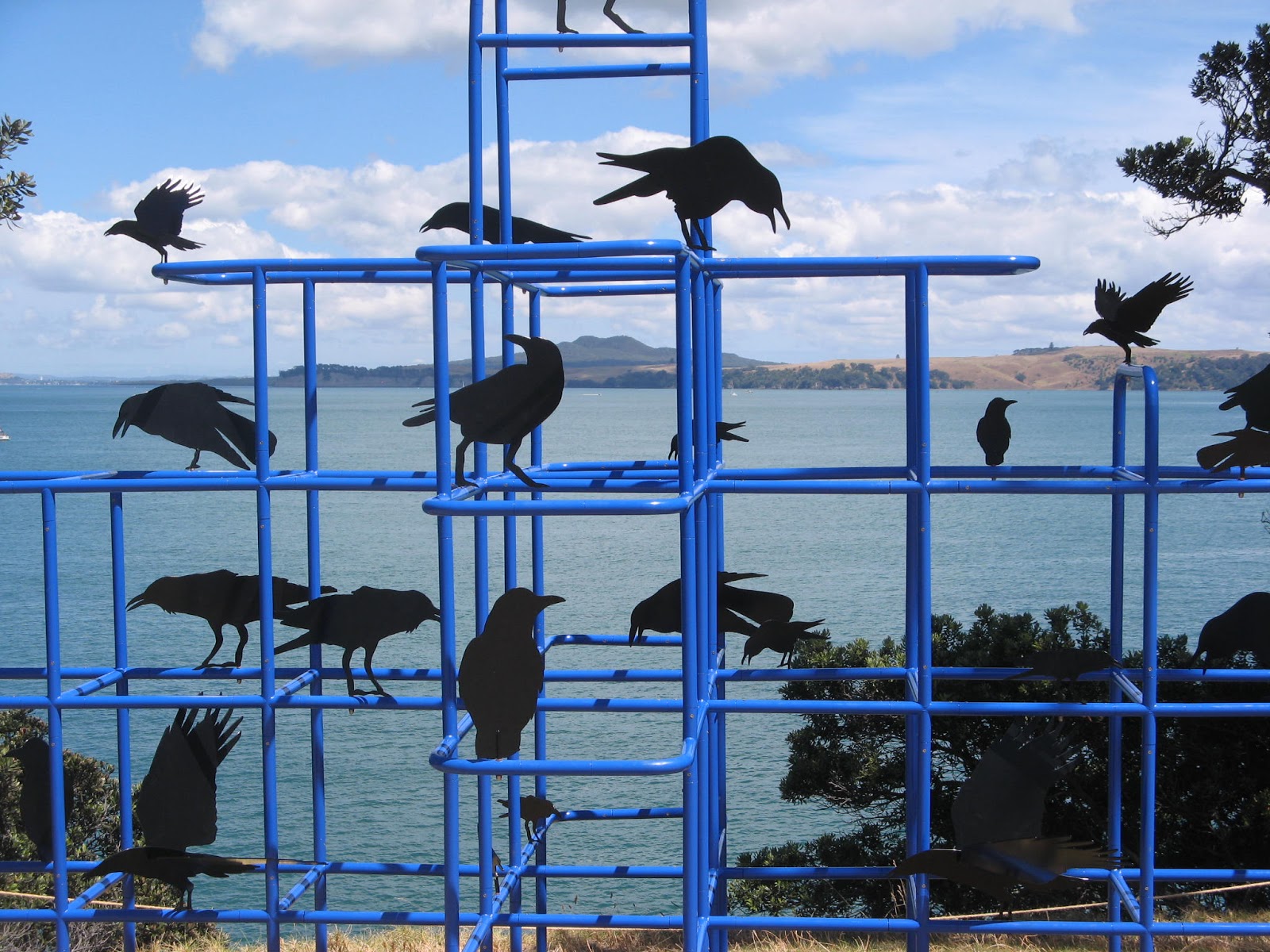
Beyond Good and Evil -  by Konstantin Dimopoulos
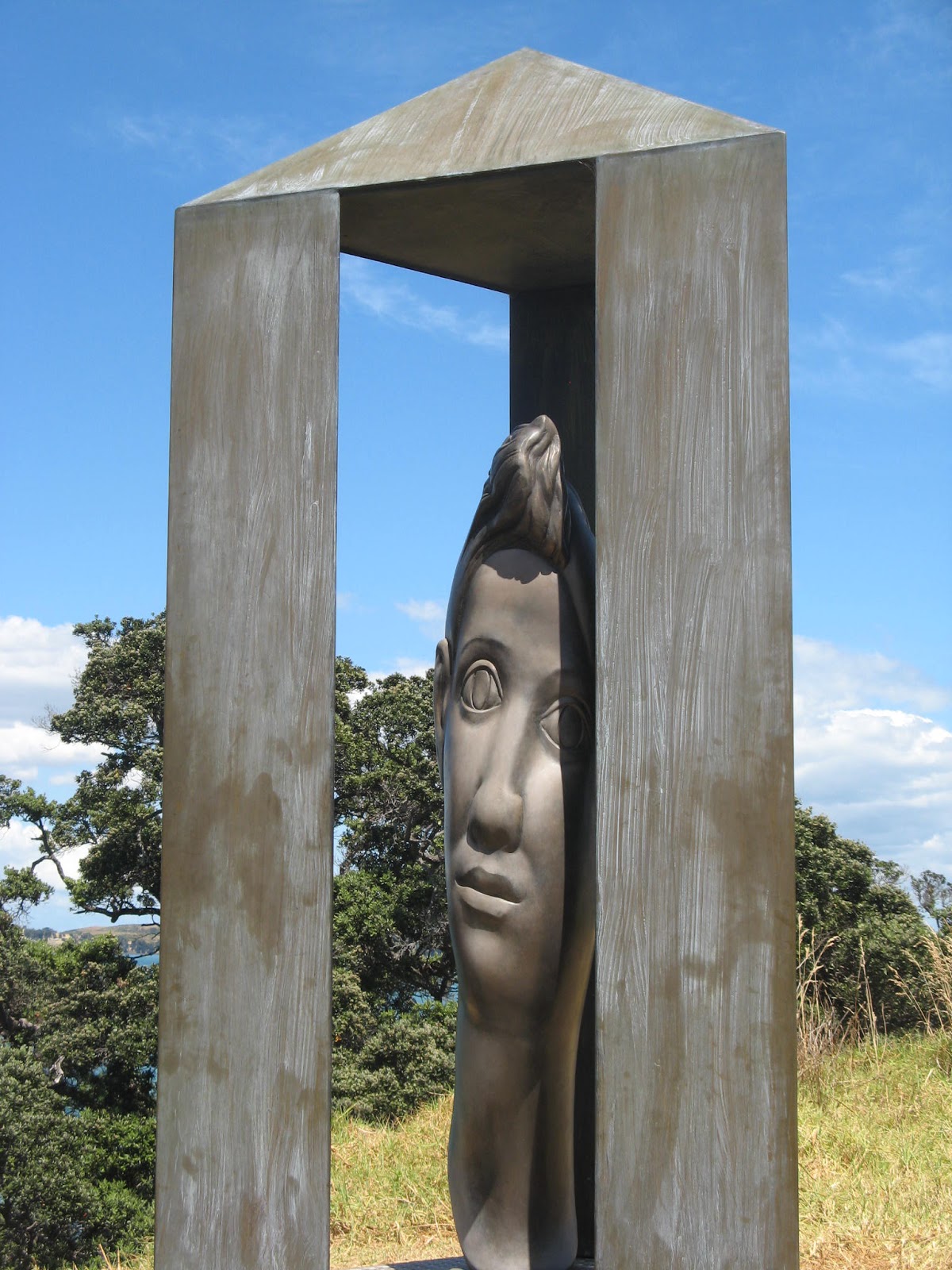
Shrine for the Sea, Soil and Sky
by Terry Stringer


 Every second year for the last ten years a local committee has worked hard to present the three week long  Headland Sculpture on the Gulf exhibition, inviting sculptors to display their work along a two and a half kilometer walk.  The walk winds around a headland taking in some magnificent scenery, passing above pristine waters and, yesterday, when I did the walk, affording views of cavorting orcas in the bay. The Headland Sculpture Trail has  become world renowned attracting 32,000 visitors in 2011. It is a leisurely one and a half to two hours walk with, this year, 30 art works to enjoy.
Every Home Should Have One -
trompe l'oeil by Peter Lange


Temporary - by Delicia Sampero
Most of the sculptures are installation works and are generally thought provoking. Strolling the trail is a wonderful way to spend a couple of hours on a glorious summer's day,  enjoying the stunning natural panoramas and pondering the art works interspersed along the way.

 
Wildfire - by Sarah Brill


At the cool, airy Pavilion, base for the exhibition, are a bar a restaurant and a shop selling art works.  Live music is played each day and visitors can attend talks by the artists or just relax for a while before catching the ferry home. If there is time it is easy to explore the main town on the island, Oneroa, a short walk away, which has an excellent  Community Art Gallery, a number of  restaurants and
shops and a beautiful, sheltered beach for swimming.
Although I have holidayed at Waiheke many times over the years this was my first visit to the Waiheke sculpture exhibition.  I thoroughly enjoyed it and intend to make it a "must do" for the future.
Part of the headland with the art work, Pavilion Structure - by  Gregor Kregar,  just visible in the distance

Death Row - by Regan Gentry
This is a tribute to a dearly loved local store which was destroyed by  fire


...and at the end of the walk a crisp glass of local wine in The Pavilion
while listening to cool jazz...what a great day out!
www.sculptureonthegulf.co.nz
www.waihekeartgallery.org.nz

Tuesday, 29 January 2013

Flavigny Sur Ozerain ....and Chocolat

Flavigny is in the Burgundy region of France, about an hour from Dijon.  It is famous for its aniseed sweets and as the location of the film "Chocolat", a fact that draws in the tourists. It is easy to see why it was chosen for the film, it is utterly delightful, in fact my sister-in-law, Mary, and I agreed it was the prettiest village we saw during our travels in France.  It is tiny, with a population of around 320, and is built on a hill around a Benedictine abbey which dates back to 719. Monks still inhabit the monastery and, if you are lucky, you may catch their Gregorian chants if you are in the village at the right time.


Walking through Flavigny is like walking back in time.  Tiny cobbled lanes wind between quaint stone houses with their ubiquitous blue shutters and colourful window boxes, the only sounds to be heard are birds chirping or the occasional  greetings called between villagers. It was very peaceful with hardly anyone around as Mary and I picked and poked for a couple of hours, idiotic grins plastered on our faces....we were in love with this village.  At one point we ventured into a shop selling an assortment of crafts, antiques, paintings and books.  The owner was a delightfully bohemian woman in her thirties who appeared to live in the shop, we spotted a bed behind a curtained off area,  her young son was playing with toys in part of the shop which looked like a living room.  We felt as though we had walked into a film set and as we wandered on we imagined a film script to suit her.  At mid-day the angelus bells rang from the village church and a priest, traditionally dressed in a soutane, strolled down the road to the church.


 Lunch time called and we lucked into a fantastic find.  Unbeknown to us we were to have the best meal we were to have on the whole trip.  In the church square is the La Grange Farmhouse Restaurant.  Although the streets of the village were very quiet the restaurant was busy with people arriving all the time.  We knew it must be good.  On a tiny kitchen sized stove a middle aged woman was producing delicious meals, real farmhouse cooking.  The menu consisted mainly of flans, of all description, most savoury and some sweet.  These were served with simple tossed salads.  The food was so mouth wateringly delicious we were at a loss to know how it was done.  We watched as the salad was tossed fresh for each customer and could see that the ingredients were simple and straight forward nevertheless we had never tasted salads so good.  There must be some magic in Flavigny.
 
After lunch, and buzzing with delight at it all, we visited the famous Flavigny aniseed shop located in the old convent.  These sweets, in their beautiful tins and consisting of many flavours, all including aniseed, are famous all over the world.  We had a great time sampling and bought several tins each as gifts. Also in the village is a textiles museum, unfortunately it was not open while we were there but we peered through the windows for a small glimpse of their displays.

 Flavigny is a delight, the epitome of a romantic French village seemingly untouched by time yet with several discreet businesses, reminiscent of the chocolate shop in the film Chocolat, which keep the locals employed.