Sunday, 20 May 2012

Napier - the Art Deco capital of the world

Many small towns claim to be the world capital of something or other in order to make their mark and draw tourists in.  Their claims are often just that, claims, however, Napier's claim to be the Art Deco capital of the world is a more realistic one.  The only other city in the world to have, perhaps, an equal claim is South Beach in Miami where the prevalent architectural style is Streamline Moderne, a later Art Deco style.
Art Deco colonnade on Napier waterfront - a memorial to those
who lost their lives in the 1931 earthquake

The massive earthquake, measuring 7.8 on the Richter scale,  which struck Hawke's Bay, and Napier in particular, on February 3rd 1931 remains the biggest earthquake in New Zealand's history with the greatest loss of life. 256 people died in the region and the town of Napier was reduced to rubble.  What remained standing was soon engulfed in a fire which smoldered for days.  Because the water pipes had been fractured firemen could do little but stand by and watch the city burn.  Both my parents-in-law were in the earthquake and it was something they never forgot and talked of often, right up to their deaths.

Overlooking the suburb of Ahuriri. The flat land in front of the mountain
 range was  thrown up from the seabed in the earthquake.

This terrible tragedy, however, has had some very positive spin offs. 9000 acres or 3600 hectares of land was thrown up from the sea bed and  marshland on the edge of the town giving Napier room to expand and to provide a site for the city's airport.  It also gave the city a chance to rebuild in a modern style which it did in an astonishingly short two years.
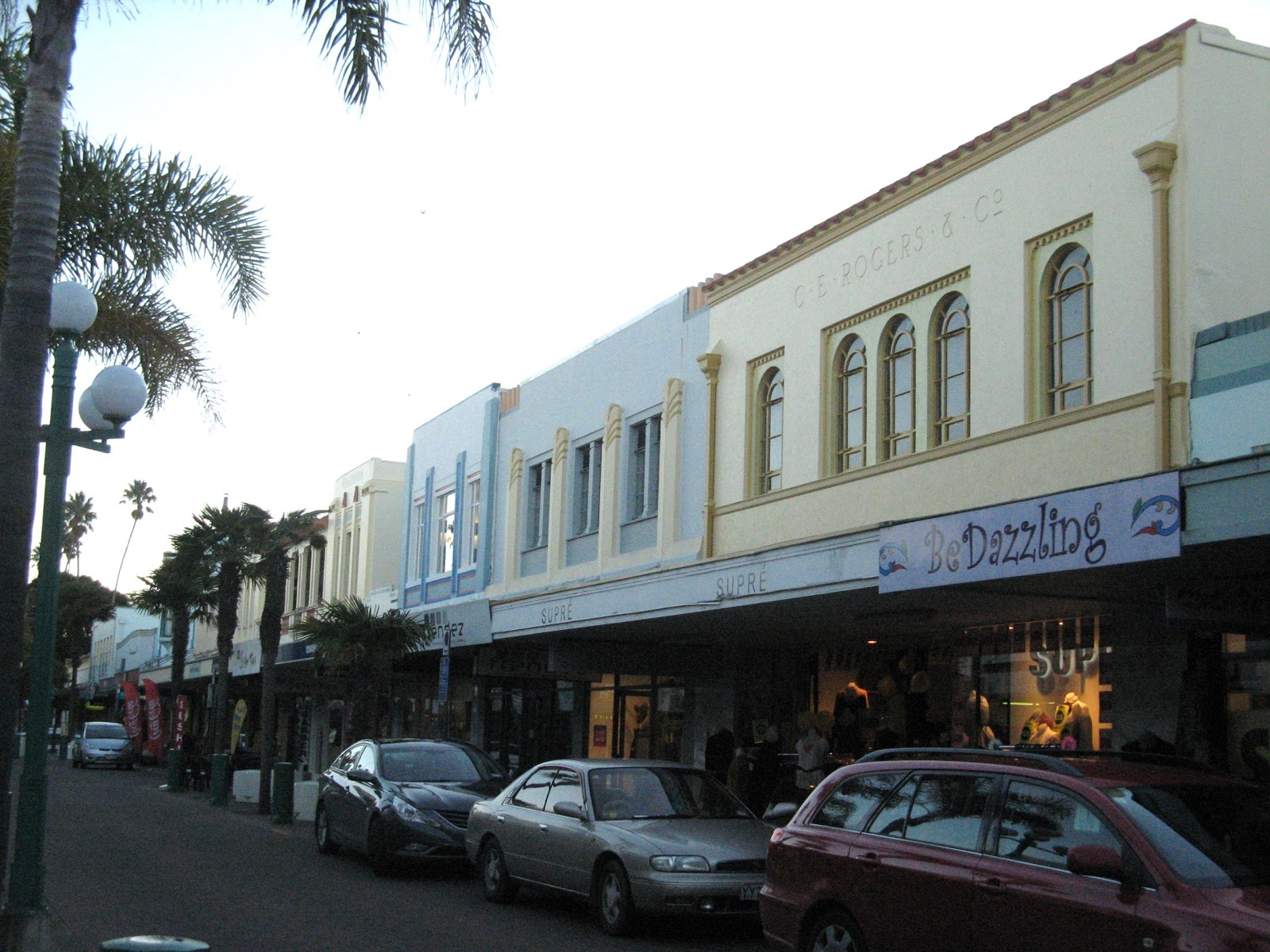


Main street Napier.

The fashionable style of architecture at the time was Art Deco and it was ideal for the rebuild.  It's stucco construction was economical, it was a move away from the heavy masonry which killed and maimed so many in the earthquake and it provided Napier with the image of a city looking to the future.  Although other styles, such as Spanish Mission and Stripped Classical, were used in the rebuild it was Art Deco with, in some cases, the unique New Zealand twist of incorporating Maori motifs, which was the most popular.


Since my late husband's relatives on both sides of his family are from Hawke's Bay we were regular visitors there over the years.  I remember the first few times I visited Napier it looked  shabby and old fashioned, but not any more.  Napier has embraced its Art Deco heritage with pride and the city now looks wonderful.  The buildings are protected, restored, maintained and treasured. The soft ice cream colours of the buildings and the palm tree lined streets evoke the 1930s era of glamour.


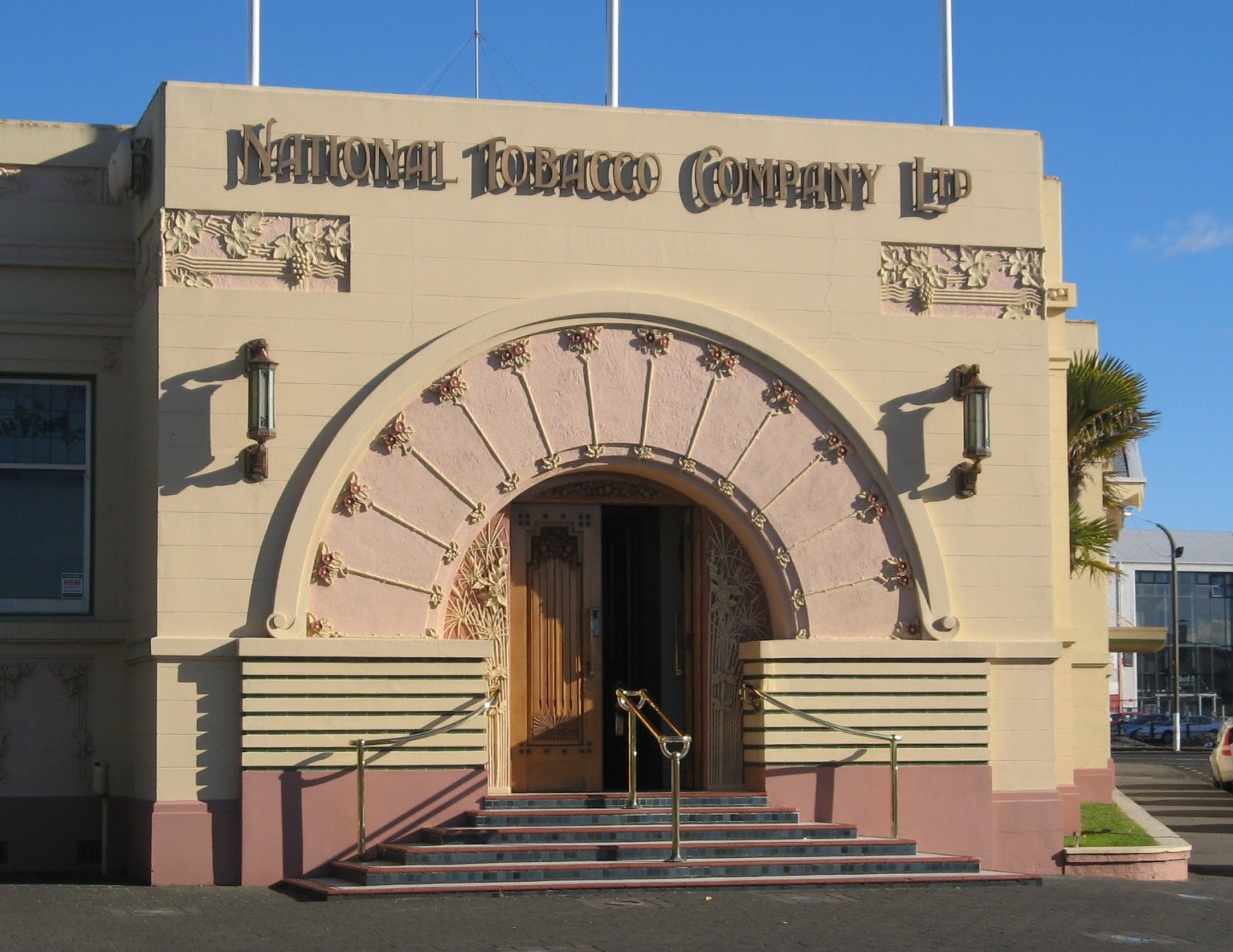
The much photographed Tobacco Company building is a mix of Art Deco
and Art Nouveau styles


 Each year in February the city holds an Art Deco festival with over 200 events celebrating the 1930s and 40s.  People flock to it from all over the world to enjoy the huge vintage car parade, a Great Gatsby style picnic, garden parties and jazz concerts among a myriad of other events. All year round walking tours, organised by the Art Deco Trust, are available for visitors.  I have done one and loved it.  On my visit to Napier last week to visit family and friends I spent a lot of my time just walking around the city centre enjoying the Art Deco architecture and detailing.  There is so much to see, it was a real pleasure and is definitely a "must see" city for any Art Deco enthusiasts.


Shop front detailing, Napier


Thursday, 26 April 2012

Waipu - golf, stunning scenery and history

One thing, among many, that we are blessed with in New Zealand is an infinite number of beautiful and accessible golf courses.  As a keen golfer it is always a pleasure for me to play on a course I have never played before so last week when a couple of friends invited me to join them for a game at Waipu I jumped at the chance.  Waipu is just south of Whangarei, around an hour and a half's drive north of Auckland. It is a well groomed, coastal, links course with stunning views and excellent greens.  We had a brilliant day strolling down the fairways under glorious skies with waves rolling in on the shore and  dramatic islands dotting the sparkling sea. We were charged only $10 each green fees and  pretty much had the course to ourselves.  It was a great way to spend a day. HINT: The green fees vary from day to day and depending on the time of day so check with the club beforehand if you want to be sure of the charge. www.waipugolfclub.org.nz


Views of the Waipu Golf Course


The nearby tiny village of Waipu boasts a museum recording one of the most remarkable migrations to New Zealand.    Scotsman Norman McLeod was a feisty character who lost his preaching license in his village in Scotland due to conflict with the established minister and consequently left to settle in Nova Scotia, Canada in 1817. There was already quite a large settlement of Scots there due to the land clearances in Scotland and many others soon followed.  By this time Norman was a fully ordained Presbyterian minister and his stern, firebrand style appealed to many of his fellow countrymen who became faithful followers known as Normanites.  After a few years of harsh weather conditions and failing crops the Normanites led by Rev McLeod decided to try their luck in Australia.  The sea trip was gruelling and challenging but they finally made it.  Australia, however, was not the promised land they had hoped for, land prices had soared due to the gold rush and three of Rev McLeod's sons died of typhus there.  The struggling group once again,  looked for greener pastures.  They made a plea to Governor Grey of New Zealand for some land, he obliged and the Normanites sailed for New Zealand settling in Waipu and the surrounding area in 1853.  Eventually others followed from Scotland with the number of settlers rising to almost 1000. They spoke Gaelic, maintained their heritage and thrived in New Zealand. Today their descendants number tens of thousands. Although Gaelic is no longer spoken and there has been much intermarriage  Waipu is still immensly proud of its Scottish heritage with a Scottish Heritage shop and many of the street names reflecting the history of the Normanites, there is even a registered Waipu tartan.  In order to celebrate its heritage the village holds an annual and highly popular Tartan Week and Caledonian games celebrating all things Scottish..


The history of the Normanites is reflected in the street signs. The museum at Waipu is worth a visit.  It is an excellent, small museum with audio visual and interactive displays and a superb gift shop with a wide range of products including tartan rugs which can be made to order. www.waipumuseum.com


Tuesday, 27 March 2012

Puhoi and Kayaking the Puhoi River

For more years than I can remember I have told my family that I wanted to kayak the Puhoi River.  For one reason or another I never seemed to get round to it.  In the end, (probably from sheer desperation!), my son and daughter-in-law gave me a voucher to do it for Christmas, so, a couple of weeks ago, on a fine autumn day, I finally achieved my ambition.  It was worth the many years wait!

The Catholic church of Saints Peter and Paul
A roadside shrine in Puhoi


Puhoi, about an hour north of Auckland, is one of only two designated ethnic villages in New Zealand.  It was settled 150 years ago by immigrants from Bohemia, now the Czech Republic, and still retains much of its Bohemian character.  It is picturesque and quaint and is one of my favourite "drive in the country" destinations. I deliberately arrived early in the day so that I could have a wander around the area.  The village is tiny with  just a church, a small but very interesting museum, the famous Puhoi Pub, a general store, a village hall and a few other business scattered around and about.  Both the church and the graveyard, located a mile or so down the road, remind the visitor that this is a Bohemian settlement.  The Czech names of Wenzlick, Schollum, Straka and several others feature strongly in both places.  I enjoyed a wander around the graveyard finding the graves of ancestors of friends descended from the original settlers.  It is an idyllic final resting place in a peaceful valley overlooked by a bush clad hillside.  A little further along the road is the well known Puhoi cheese factory where I enjoyed a tasty cafe lunch beside a serene lake complete with water lilies and fountains. On this occasion I did not go to the Puhoi Pub but have other times and it is certainly worth a visit.  It is a real old time pub crammed with photographs, artifacts documenting the history of the area.  On occasions the famous Puhoi Bomehian Band plays there.  The band was founded when the settlers arrived and includes the Czech bagpipe or dudelsack.  I have heard it play in the past and it is a wonderful and lively example of a folk orchestra.

Early afternoon I make my way to the Puhoi Kayak Company and after a briefing and instructions set off alone to kayak the eight kilometres down the river from Puhoi to Wenderholm, a coastal reserve. What a great way to spend an afternoon quietly paddling along helped by the out going tide. Bush and fields line the river's edge, cattle graze, an occasional fish jumps and birds sing from branches overhead.  At one point the river is crossed by a bridge carrying traffic on the busy main highway north.  This brief noisy interruption only serves to make the rest of the journey seem more tranquil. 


About halfway through my trip I am joined by a couple of  men also in kayaks and we travel the rest of the way quietly chatting together.  It takes around two hours from Puhoi to Wenderholm where we are met by the Kayak company owner who loads our kayaks onto a trailer and drives us back to Puhoi to our cars.  I am well satisfied with my afternoon's kayaking and so pleased it is something else to tick off my "to do" list.  I am certain I will do it again but, hopefully, will not wait so long to get around to it next time.

At last....job done!!

Monday, 12 March 2012

Cruising the Bay of Islands on the Ipipiri

I thought it was time I tested the waters - literally!- and went for a cruise.  As a single person I wasn't sure how I would feel to be on a boat with everyone else in couples but I shouldn't have worried, I had a wonderful time on this overnight cruise around the stunning Bay of Islands north of Auckland.
Kayaking from the Ipipiri

The Ipipiri is a beautiful cataraman, 44 metres long, 13 metres wide and 11 metres high. It has 4 decks and 30 identical cabins with kingsized beds, en suites and panoramic windows.  The name Ipipiri means "many places" an appropriate name for a boat which cruises around and amongst the 144 islands in the bay.


A secluded historic homestead in the bay
Although the boat can take 60 there were only 23 passengers, on this trip;  a couple from England, a couple from the USA a Taiwanese family and the rest from Australia with me the only New Zealander.  Needless to say that with 9 crew  we were well looked after. We left Opua, the Bay's deep water port, around midday for a slow cruise past Russell, a picturesque and historic village which, while sleepy now, has a colourful past including being the first capital of New Zealand.  The captain provided us with an entertaining and informative commentary on the history of the area as we meandered around the bay and got chatting to each other whilst drinking in the stunning scenery.  We were invited to chose activities for the afternoon which included kayaking, snorkelling, swimming or bush walking or just staying aboard the boat and relaxing.  I chose kayaking.


Kayaking, snorkelling, bush walking.... Ipipiri in the background


The captain found a sheltered anchorage off Moturua Island and we were all set to go.  A large grill stern plate came up at the back of the boat and all the kayaks were lined up on it.  We got into the kayaks and then the plate was slowly lowered into the water and away we went.  A brilliant system. About a dozen of us set off to pick and poke about the bays and coves in smooth water so pristine we could see right down to the sea bed. After about an hour we pulled up on the beach to meet the others who had elected to bush walk or snorkel.  I decided to do the bush walk too and headed off up the track, meeting the others on the way down.  I continued to the top  alone relishing the peace, tranquillity and sheer beauty of the area.  This island is a nature reserve so is thick with birdlife and song.
The well named Bay of Islands from my bush walk

Convivial dinner time
Back aboard the boat it was time for showers, fresh clothes and evening drinks from the bar with platters of complimentary finger food before dinner.  We sat around chatting as the sun went down turning the sea a burnished gold. A full buffet dinner of delicious, fresh local foods was laid out and  about a dozen of us joined our tables together and enjoyed a big friendly, chatty evening getting to know each other.  One of the couples had a very dramatic story to tell.  They had simply got on the wrong bus in Auckland thinking they were being taken to an Auckland harbour cruise.  The bus driver protested but they assured him they were on the right bus...all they heard was the word "cruise".  They had arrived in the Bay of Islands with nothing but the clothes they were wearing and had already paid for accommodation  in Auckland.  Needless to say they realised something was wrong when their expected 15 minute bus trip took 4 hours!   Undaunted they had gone to an Op shop in Paihia, bought some clothes and were happily enjoying their unexpected cruise, while trying to forget the unexpected price tag!

We anchored for the night in  a sheltered bay off Motuarohia Island and with the fresh sea air and afternoon activities taking their toll were all in bed early.  I left my blinds up and fell asleep looking out on a glass-like sea reflecting a full moon and a million twinkling stars....magical.


Everyone was up early the next morning to a full cooked breakfast and more chat with new found friends. The captain spotted some dolphins in the bay and headed across to view them.  I have seen plenty of dolphins in my time but nothing like this before, it was spectacular.  There would have been around 50 of them and the captain said they were probably mating.  They put on the most amazing performance, leaping into the air, looking us right in the eye, cavorting around each other, rolling on their backs and swimming right under and around the boat.  They were showing off and we were captivated.


My family and I stayed in this historic cottage on the waterfront at Russell
But, sadly, it was time to head back to port...our cruise was coming to an end.  The captain invited anyone who wished to join him on the bridge.  A few of us took up the offer as we cruised back to port.  Opua looked serene and beautiful under an overcast sky as we tied up at the dock and boarded the bus back to Paihia. We swapped e-mail addresses and I arranged to take the American visitors on
a tour of Auckland the next day. There were a few hours to fill in before the coach trip back to Auckland so I took the ferry to Russell and enjoyed a wander around this lovely village, remembering the many good times I had had there with my husband and sons and lingering over lunch at a seafront cafe.
Sightseeing in Auckland the next day with my new American friends
 
I would highly recommend this cruise as a taste of what life must be like on a super yacht.  It is probably the best tourist activity I have ever done in New Zealand and I would happily do it again.  Everyone was friendly and as a single person I did not feel the least out of place or excluded.

www.overnightcruise.co.nz

Thursday, 1 March 2012

Taieri Gorge Railway - Otago

Mary at Dunedin Railway Station


I love to do things spontaneously when I'm travelling...not having too much planned...seizing opportunities.  It all adds to the spice and excitement of travel.  And so it was that when I was in Dunedin recently with my sister-in-law and we spotted a half day train trip through the Taieri Gorge we said, almost in unison, "Let's do it!"


The Taieri Gorge Railway leaves from the stunning, much photographed and admired, Edwardian, Dunedin railway station, complete with Royal Doulton mosaic tile floors, and runs through central Otago to Pukerangi.  A couple of days a week the train goes a bit further on to Middlemarch but our trip was to Pukerangi and back, a distance of around 58km each way.
Crossing the Taieri Plain
It is an historic route, construction of the railway having started in 1879.  By then the Otago gold rush was over and the region was looking at new ways to develop the economy.  The railway helped by opening up farmland in a remote and inaccessible area, making it easy to move stock and produce.  In fact the line was used for commercial purposes right up until 1989 and was particularly useful for moving the steel and cement used to build the Clyde dam in central Otago. Today the railway is one of Dunedin's biggest tourist attractions.

Hillsides dotted with sheep
The first part of the journey heads south through Dunedin's suburbs and then north-west across the Taieri plain with panoramic views across to the hills. Then it is into the longest tunnel of the journey, 437m, before bursting out into the Mullocky Gully (don't you love that name?) and along to the Taieri River. The train follows the river, clinging to the side of the gorge, crossing a dozen viaducts and  through 10 tunnels in a  spectacular landscape, very reminiscent of the highlands of Scotland. 


The tracks cling to the hillside and follow the river


The Christmas Creek Viaduct.  So named because gold was discovered here
 on Christmas Day 1863


Here I am at the tiny Hindon Railway Station
The Wingatui Viaduct above the Mullocky Stream is one of the largest wrought iron structures in Australasia.  It passes through, and sometimes stops at, tiny railway stations and some, abandoned,  settlements.  It is hard now to imagine the thriving railway communities that once lived in this tough, isolated environment.  There is no doubt they must have been strong, hardy souls. Pretty much the only signs of life these days are the sheep grazing the steep hillsides. One former station master's house is now used as a holiday home, purchased for about 35 pounds when no else wanted it,  it is without power or piped water but the owners clearly love it....it is pristine and set in a beautiful garden.  The owners gathered on the lawn and waved happily at us as the train went by.
The old station master's house

A typical view on the journey
The trip was a nostalgic journey for me.  The charming heritage railway carriage we were in, dating from the 1930s, was identical to one I travelled to school on...No, I am not that old...the carriage was old even then!   We thoroughly enjoyed standing out on the open viewing platforms with the wind blowing through our hair. Mary, who loves trains, grinned the whole afternoon. The turn around point was at Pukerangi where we had a few minutes to walk in and admire the landscape, we felt we had stumbled into a Stanley Palmer painting (well know artist of Central Otago landscapes).  This is a great trip and an easy way to experience the slendour of Central Otago if even for just a  few short hours.
The glorious Central Otrago landscape at Pukerangi

www.taieri.co.nz

Tuesday, 14 February 2012

Oamaru - New Zealand's finest Victorian town

Main Street of Oamaru
Oamaru is an easy 115 kilometre drive north of Dunedin and for a heritage or Victorian era buff it is well worth the trip, in fact, I'd say, it's not to be missed.  I quite like this quote from Peter FitzSimons, a well know Australian former rugby international and raconteur who called Oamaru "New Zealand's best kept secret, which is itself the world's best kept secret".  Reputed to be the finest built town in New Zealand the scale and grandeur of many of its civic buildings is astonishing and unexpected in what was originally settled as a small service town for the surrounding farming industry.   It was Oamaru's good fortune to be an early player in the export of frozen meat to the UK bringing great prosperity to the town. That and  the ready availability of fine white local limestone meant it wasn't long before grand banks and offices were being erected in the then fashionable classic style.  It seems  almost bizarre that  a town of only 13,000 inhabitants should have such huge, grand, pillared banks, grain stores, an opera house, a courthouse, churches and a post office, none of which would look out of place in London, Paris or Washington DC.  A stone's throw from the main street is the town's Victorian Heritage Precinct. The shift of commerce to other areas and the closure of the port in the 1970s left this area largely original and untouched. Now old grain warehouses and storage buildings  house shops, galleries, and food stores.  There is even a whiskey tasting shop and the Loan and Merc, the second restaurant belong to Fleur Sullivan of Fleur's Place, Moeraki.


The Victorian Heritage Precinct.  The large building at the far right houses
the Loan and Merc restaurant
Mary in the Victorian Heritage Precinct
My sister-in-law, Mary, and I spent a happy afternoon picking and poking around Oamaru.  I had been there many years ago but could barely remember it so it was a novel experience to see it as if for the first time. We wandered the main street admiring the fine buildings and then  past the Steampunk HQ...for those of you into Steampunk, Oamaru calls itself the Steampunk capital of New Zealand. We visited art and craft galleries and marvelled at the penny farthing bicycles for hire and, no, we weren't tempted! We poked our heads into the Victorian Tea Rooms where the serving staff dress in Victorian costumes - the waiter was sporting a luxurious pair of mutton chop whiskers -  and serve delicate teas on pretty china cake stands.     Then it was on to Fleur's Loan and Merc for a drink where we sat back on large comfortable leather settees and enjoyed watching the clientele come and go.  The Loan and Merc is located inside a large old grain warehouse, and is a completely different style of restaurant from Fleur's Place at Moeraki. This restaurant is vast and filled with long refrectory style tables and benches, the grain mill equipment  still in place.  The meals served here are carvery style, totally in keeping with the venue, but as it was the afternoon  we just had a drink in the comfortable bar enjoying the views out into the harbour.
Serving maid in the Victorian Tearooms.

There is a lot more to explore in Oamaru including little blue penguin and  yellow eyed penguin colonies, vintage train rides, attractive gardens and the popular Whitestone Cheese factory. Oamaru's Riverstone Kitchen was named New Zealand's Restaurant of the year 2010/2011. Oamaru  is also the birthplace of a number of famous New Zealanders, including one of our best known writers, Janet Frame.

However, as we were staying in Dunedin we didn't have time to investigate everything before making the drive back....a good excuse to return to Oamaru some time, I say!