Monday, 15 April 2019

The Great Wall of China

The view from the bottom of The Great Wall looked challenging and somewhat daunting  but I couldn't wait to climb it.  This is an absolute "must do" on any tour of China and we were finally here. It is fair to say I was pretty excited, especially since climbing the wall was on my bucket list and something I  never thought I would get to do.    

The Great Wall snakes its way over hills and through valleys
 The atmosphere of excitement on our bus was palpable as we wound our way out through the suburbs of Beijing and through the countryside towards the Great Wall. It took around an hour and a half to get there but it seemed that one minute we were on the outskirts of Beijing and the next minute we were in a mountainous area looking at the Great Wall snaking its way across the hillsides.  Thrilling!

Once again it was a magnificent day with sunshine, blue skies and cool crisp air, perfect conditions for our climb up a restored part of the wall. The 6000km long wall includes parts in good condition and other parts which are derelict. There are several areas where many of the stones were filched by locals to build houses during the cultural revolution.


Two watchtowers on the section we climbed


Construction of the Great Wall began 2000 years ago, firstly as protection from Mongol invading armies and then later as a means of border control for duty collection as part of the silk road.  It has been built and rebuilt many times with the current wall being built during the Ming Dynasty (1368 - 1646).  It is estimated that over 1 million workers died during the construction of the Qin dynasty (221 - 207 BC) period.

Our guide was quick to point out that it is a myth that the Great Wall can be seen from space.  Although this is a widely held belief it makes sense that it can't be seen being only 29 feet wide and pretty much the same colour as the surrounding landscape.

View from a watch tower


We had arrived early so luckily there were few people around therefore no pressure and plenty of time to enjoy the experience.  After staring up in awe for a while I couldn't wait to start the climb. It is very steep and the step treads range from shallow to deep in no set pattern.  It is quite an effort to ascend to the first watchtower but well worth it. The views over the countryside are panoramic and it is breath taking to see the wall meandering its way into the distance over hills and valleys.  I stopped for a while at the first watch tower before heading up to the second one.  


It is steep!


Coming down was more difficult...it is very steep so I clutched a hand rail most of the way.  Near the bottom a young boy of about 10 was sitting on a step paralysed with fear.  His family could not get him to go up or down.  I felt so sorry for him. One of our group, a fit runner, sprinted up and managed to make it to several watch towers.  Another uses a walking stick, due to knee problems, but was so determined to climb up the wall she did part of it using her hands and feet.  Full marks to both of them! 


All set to head up.  Excited!


I was fizzing when I arrived back at the bottom. It is always a thrill to achieve a long held goal and get some pretty hefty exercise into the bargain, maybe that would make up for some of those  dumpling dinners! 
At the bottom.  The wall can be seen on the ridge behind

When I arrived back in New Zealand I told someone I had walked on the Great Wall, she asked if I had walked all of it!  As if!


Tuesday, 26 March 2019

Beijing - The Heavenly Temple and locals at play

One of the things I love most about travel is learning about and experiencing another culture.  I enjoy seeing locals go about their normal lives and, if possible, joining in, which is why dancing with the locals at an exercise class in Xi'an was such a thrill.  In Beijing we were making a visit to The Temple of Heaven and our approach through the Long Corridor located in  the 267 hectare (660acre) park which surrounds the Temple gave us the perfect opportunity to mix and mingle with the locals and see them enjoying some leisure time. 
The Long Corridor
The long corridor, originally built as a passageway for the delivery of offerings to the gods, is now a favourite hang out for elderly Chinese as a place for them to play cards, listen to the radio, play instruments, sing or show off their pet birds.  It is my kind of place.  Our guide told us that since the retirement age for women is 55 and for men 60 and most Chinese, despite the abolition of the 'one child' rule, have one child only, older Chinese find they have a lot of time on their hands so enjoy the camaraderie of joining together in the park to share their hobbies. They seemed like happy souls and we were greeted warmly by everyone we passed.  Some of our group admired pet birds and their proud owners were only too keen to allow the birds to perch on my fellow travellers arms. 


There were clearly some very serious card games going on but since gambling is illegal in China players were simply playing for pride and satisfaction.  The large park also contains a Marriage Market where people can advertise for a spouse and a marriage broker will then try to find them a suitable partner. Some of the singles in our group joked that there might be an opportunity there!


But onto the point of our visit, the stunning Temple of Heaven.  Originally built between 1406 and 1420 during the reign of the Ming emperor, Yongle, who was also responsible for the building of the Forbidden City,  The Temple of Heaven consists of three main buildings with the stunning  Hall of Good Harvests as the centre piece. The Hall of Good Harvests, built entirely of wood and without any nails, was struck by lightening in 1889 and burnt to the ground. It was rebuilt to the original plan soon after. It is here the emperors came to pray each year for good harvests, good weather and prosperity. The Hall is 36 metres (118 feet) round and 38 metres (125 feet) high with three tiers and boasts absolutely beautiful, brightly coloured, painted decorations. 


Part of the complex of The Temple of Heaven, the Hall of Good Harvests in the centre
(Photo by Maros, edited by Thegreenj)
In Chinese tradition earth is square and heaven is round and the hall reflects this being built on a large square. Ornate marble terraces lead up to the hall which is a high point of the surrounding area, so it does give the impression of climbing up to heaven.  The large courtyard below houses two large oblong halls and there are many other ceremonial buildings within the complex which covers a greater area than The Forbidden City, because in Chinese tradition no man could have a greater estate than that dedicated to the gods. The Hall of Good Harvests is certainly a show stopper and with its view out over the city, countryside and out to the mountains it has a position befitting its status.


Above: The Hall of Good Harvests

Right: A Glimpse inside


We had had a full and amazing day sight seeing around Beijing so were looking forward to free time in the late afternoon and evening.  A few of us decided to find a shopping centre near our hotel and set out to walk there.  Although furnished with instructions, albeit sketchy, in the end we couldn't find it, however we did see some interesting street life along the way, like the roadside hairdressers who set up chairs on the footpath, add mirrors to the street fence and seem to have a busy time with clients judging by the amount of hair at their feet.
Roadside hairdresser, Beijing
(Photo by Dan Hartley)

 A few of us walked back in the opposite direction to a big, glamorous shopping mall, not what we were after but it proved to be another insight into modern China. The multi level mall was glossy, modern and crammed with expensive shops.  I was astonished at the prices, pretty much everything was far more expensive than they are in my home town. The shops were not the high end lines that you would expect to see at an airport, these were the same type of shops you would see in any modern mall, obviously catering to the wealthy middle classes who were shopping there in numbers and clearly indulging their only children.  China has certainly changed over the last few years.  The mall was an eye opener and an entirely different world from that of the road side hairdressers.
Modern China - congested traffic and glamorous shopping malls
Later we spent a sociable evening enjoying the company of our fellow travellers and full of anticipation for our next great adventure and one of my 'bucket list' items - climbing the Great Wall.


Monday, 11 March 2019

Beijing, China - a fascinating mix of Modern History, Politics and Ancient Grandeur

A thick orange coloured smog greeted us on arrival in Beijing, luckily,  by the next morning, the city was boasting beautiful sunny weather and the clearest of blue skies which remained with us for our whole visit.  It was a pleasant drive from the airport to our hotel  along pretty park like boulevards, the result of the controversial demolition of many houses, despite residents' protests, in order to beautify the city for the  2008 Olympics.
A smoggy welcome to Beijing
Beijing has a population of around 21.50 million and as the capital city of China is a draw card for millions of tourists from both overseas but mainly from within China.  We were pumped with anticipation, there is a lot to see in this ancient city.


In Tiananmen Square, General Assembly Building behind me
Next morning we set off for Tiananmen Square.  This is where I strongly recommend being part of a tour group.  Since Tiananmen Square is a bucket list place for many Chinese they arrive in their thousands on a daily basis and stand in interminable queues waiting to get in. We, on the other hand, led by our guide clutching pre-booked tickets, sailed past them, oblivious to the scowls and bemused stares of the crowd. 

Built by Mao Zedong, Tiananmen Square is the centre of the General Assembly of China and is said to be one of the largest public squares in the world with a capacity of  more than 1 million people.  To one side of the square is  a large monument to the Peoples' Heroes of the Revolution and Mao's mausoleum, where a never ending queue patiently waits its turn to pay respects. The General Assembly building takes centre stage and on the other side of the square is a massive portrait of Mao.  Prior to our arrival we were warned not to mention anything about the student and workers' uprising of 1989 while in the square or to ask anything about the tanks etc.  Discussion of the military crackdown is prohibited in China and there are plain clothes, secret service agents with English speaking skills located around the square whose job is to listen to conversations and make arrests if necessary.  The Chinese are clearly very twitchy about potential subversion. Actually, the agents were pretty easy to spot as they fiddled with their cell phones and lent on railings but we stayed true to the advice and just drank the whole scene in. 


Monument to the "glorious heroic workers of the revolution"
We were also told that since the square is a place of pilgrimage, which many Chinese save  their whole life to visit,  we would be a curiosity to back country Chinese who had never seen Europeans before.  Our guide even went so far as to suggest they would think we were film stars.  That's as close as I'll ever get to being one! My fair hair  and blue eyes attracted attention and I can't tell you how many photos I am in. It was amusing to notice people surreptitiously posing behind me for a shot with the strange foreigner. We had a good wander around the square, time for a quick group photo and then made our way to the entrance to The Forbidden City, right beside the square.
Inside the Forbidden City. The size of the crowd is an indication of how vast it is.
The Forbidden City, so called because entrance was forbidden to commoners, was built in 1406 and was home to 14 Ming Emperors and 10 Qing Emperors until the last emperor abdicated in 1912 when China became a republic.  Also known as The Palace Museum it is vast, covering 720,000 sq meters (7,750,000 sq feet). It contains 90 palace quarters and courtyards, 980 buildings and at least 8728 rooms. It is known as a masterpiece of Chinese architecture and boasts the worlds largest collection of well preserved wooden, medieval buildings.  
Intricate detailing on the buildings and  tiers of marble balconies.


A view across the city. The buildings on the hill are included.  The large bronze vats were kept filled with water in case of fire.
I found it an intriguing step back in time, imagining the emperors in  glorious robes walking through the vast treeless squares with servants and officials scurrying about them. 


Inside one of the palace rooms, little changed since ancient times.

The walled garden in the Forbidden
City - note the paving between
the trees


I was very taken by the beautiful, painted detailing on the buildings and the elaborate marble railings on the tiered balconies leading up to the palace buildings but, as someone who loves trees and gardens, I thought the vast paved squares with neither tree nor flower a bit soulless. Trees were not planted since they would have been good hiding places for assassins and would also interfere with the squares' primary purpose of holding grand and solemn ceremonies.  However, we did stroll through a walled garden containing large ancient trees within the city complex.  Now a UNESCO World Heritage site the Forbidden City is definitely a "must see".  It's vastness is a bit hard to take in and there is so much room that despite the fact there were many thousands of other visitors there we never felt bustled or as if we were in a crowd.


As with so many grand palaces around the world you can't help but ponder the narcissism and entitlement of those who built them and lived in them but on the other hand you can delight in the extraordinary treasures they have left which many millions of people can now enjoy.  I thought it was amazing and am so glad to have seen it. 

So far it had been a fascinating day with a mix of modern history, politics and ancient, dynastic grandeur.  There was more to come which I will write about in my next post.


Right: She looked so darned cute, I had to get a photo, with her mother's permission.

Wednesday, 13 February 2019

I loved Xi'an, China - It's way more than the Terracotta Army

After our gob smacking experience this morning viewing the Terracotta Army we were feeling pretty content with our day but there was so much more to come.


The Small Wild Goose Pagoda
Firstly we were off to view the Small Wild Goose Pagoda.  It is set  in a lovely tranquil park and with the late afternoon sun dappling the pagoda through the trees it was a lovely place to stroll, relax and spend some reflective time.  The pagoda is itself impressive. Built between 707 and 709 it is 43 metres tall with 15 tiers, the top tier having been crumbled by an earthquake in 1556.  It is said to be one of the most well preserved Tang Dynasty pagodas. The adjoining Jianu Temple originally housed a large Buddha, sadly destroyed in the cultural revolution.


The tranquil park


Right: This large bell is a replica of the original which is 800 years old and is located in the temple. Tourists swing the pole to strike the bell while praying for good fortune.

As part of our tour we were ushered to a nearby calligraphy work shop for a demonstration of the art, the idea clearly being for us to buy.  I don't think anyone did, though, and most of us thought it would have been better to spend more time exploring the pagoda and the surrounding park.


Our next stop was fantastic, albeit not long enough.  We were visiting the Muslim Quarter, a web of streets where the 50,000 Hui Muslims of Xi'an make their home.  Muslims have been part of the population of the city for 1400 years, having arrived in China via the silk road.  I love local markets so was once again in my happy place.  The street of blue stone pavers and shady trees is a vibrant, colourful, exciting corridor of food vendors selling all sorts of interesting food - squid, pomegranates, bread, fruit, pancakes, all types of skewers and candied nuts. Vendors calling out, silver smiths hammering jewelry, nuts being ground and pummeled, lots of people milling around, chatting and eating and as the day turned to dusk, lights coming on, all added to this wonderful joyful, noisy kaleidoscope of liveliness. All the vendors are Chinese Muslim and most wear traditional dress. I loved it and was really sorry we couldn't spend more time there.


But, places to go, food to eat!  We were having a pre show dinner at the Xi'an Chinese Cultural Centre.  Xi'an is proud of its dumplings and, boy, do they put on a display. We were served plate after plate of the tastiest, cutest dumplings I have ever seen. They came out in all shapes - ducks, frogs, hedgehogs, etc., an instagramer's  delight but I was so busy admiring and eating them I forgot to photograph any.


Our final activity for the day was the cultural show, something Xi'an is famous for and a great insight into Chinese theatre. As a tour group we were given VIP seats right up the front so we all had a great view.  The show tells the story of a ruthless, ambitious empress from the Tang Dynasty and draws on traditional Chinese folk dances and music with the whole cast, including the orchestra outfitted in elaborate Tang dynasty costumes.   At one point a chubby man playing the rather shrill Chinese flute  had a solo in centre stage.  He was flamboyant in his performance and looked incredibly proud of himself, you could see him thinking "I am the star of this show".  I'm always interested in cultural performances and found this fascinating, if a little over the top, but I think that is the typical dramatics of Chinese theatre.  I was so exhausted after this big exciting day that I found it hard to stay awake through the performance despite the noise and colour.  (Below is a tiny snippet from the show )


Back at the hotel I fell into bed with a happy smile on my face.  What a great day, and then I reflected on yesterday as well - walking the city wall, the night illuminations,  dancing with the locals in the street and I decided, yes, I have loved Xi'an.

Thursday, 31 January 2019

Terracotta Army - Xi'an, China - A Wonder of the World

 We were all pretty excited to be heading off this morning to see the extraordinary Terracotta Army, a major highlight of our trip to China. The Terracotta Army is an astonishing example of funerary art created  between  246-209 BC  by order of Qin Shi Huang, the first emperor of China, who was just 13 at that time.  More than 700,000 workers worked on the army designed to protect the Emperor in the after life.

Ornate Chinese furniture
Of course, there was the obligatory commercial stop before reaching our destination but  the demonstration at the factory, which produces good quality replicas of the army, was interesting none the less.  We spent more time than we wanted to in the adjoining shop and were all itching to get going to view the actual army but I was rather pleased with the model of a general I bought and admit I was fascinated by the extremely ornate furniture for sale in the furniture gallery.

At last we were off, a short bus ride and then about a 15 minute walk from the parking area to the actual pits to view the army. I enjoyed the walk on this clear sunny day, a row of misty mountains forming a romantic backdrop to the site. Being part of a tour group has both advantages and disadvantages.  You are obliged to visit commercial enterprises that don't really interest you but you also have immediate and preferential access to places of interest. We were through the gates in no time accompanied by a local guide who gave us an interesting talk about  the history, origins and discovery of the army, prior to us entering Pit 1


The vast Pit 1. Restored warriors in front, shattered warriors behind.  
It is hard to put into words what an incredible sight Pit 1 is.  To put it into some sort of perspective it is 230 metres (750ft) long by 62 metres (203ft) wide and contains more than 6000 life sized figures in 11 brick paved corridors.  The ceiling, which  would have been beam and post with a woven reed matting over the top, eventually rotted and collapsed  shattering the warriors.  There they lay buried for around 2000 years until some local farmers decided to build a well in 1974 and discovered fragments which led to a massive, and ongoing, archaeological dig.  No one knew how immense the site would be and in fact ground radar and core sampling suggest that there may be as many as 100 more, as yet uncovered, pits in the surrounding 98 square kilometers (38 square miles) of countryside.


Fragments laid out ready for assembly ....
....and completed warriors.  


All the complete warriors have been painstakingly restored. It is estimated that this site contained 8000 warriors, 130 chariots, 520 horses and 150 cavalry horses.  Most would have been carrying weapons although it appears many weapons were  looted at or soon after their creation. Even so around 40,000 bronze items of weaponry, such as swords, daggers, spears and arrow heads have been discovered in and around the pits.
How the pits appeared when uncovered. A jumble of parts caused by the collapsing roof.
The army was originally painted with
vibrant lacquer like this.  It must
have been an amazing sight

(Photo by Mary Harrsch)
The figures were modeled in parts and then assembled.  Hands, arms and heads were made in molds with the final details hand carved later. There are distinctly different faces on the soldiers who wear uniforms and hairstyles particular to their rank with generals being larger in size. Originally painted in bright lacquer it was found that the lacquer dissolved quickly with exposure to air leading archaeologists to believe the pits may have been hermetically sealed.

Pit 1 is  a vast and extraordinary sight but the other much smaller pits, 2 and 3, are no less interesting.  Pit 2 is considered to be the most complete discovered so far as it contains infantries, cavalries, charioteers and archers.  It covers 6000 square metres (7176 sq yards) with only approx one sixth of it excavated so far. The building housing Pit 2 also contains an exhibition hall where you can view  some of the  warriors and two spectacular bronze chariots close up.
Newly restored and partly restored warriors  and horses in Pit 1
Pit 3 is the smallest of the three pits at 17.6 metres long (19.2 yards) and 21.4 metres (23.4 yards) wide.  Because of the positions of the warriors it is believed to be the command centre for the army. Gold and bronze decorations and a distinctive chariot and four horses were also discovered in this pit.

I was absolutely thrilled to view the Terracotta Army. It is, to my mind, one of the wonders of the ancient world.  Although it has UNESCO protection it amazes me that it does not feature on lists of wonders of the world.  I have always believed that we should not try to put our 21st century brain into the head of a person from earlier times to try and second guess their thinking.  Was the creation of the army unbelievable narcissism, or was it something else?  I guess we will never know.  It did get me thinking, though, that if this was discovered as recently as 1974, quite by chance, what else is there as yet undiscovered in the world.  Who knows? 

Thursday, 17 January 2019

Xian, China - an ancient city of lights

I have a confession to make.  Before booking this trip to China I had never heard of  the city of Xi'an, or if I had it hadn't registered. A bit embarrassing really since not only  is it  the capital city of Shaanxi province, but it also has a very long and fascinating history, is the eastern end of the fabled silk road and  the location of the pits containing the famous Terracotta Army, a sight high on my bucket list.  Xi'an is one of the oldest cities in China. Lantian Man, dating from at least 500,000 years ago, was discovered near the city and so were Neolithic settlements from up to to 6700 years ago. Well, you are never too old to learn and one of the things I find most rewarding about travel is discovering and learning abut new places.

Our arrival in the city was greeted by blue skies and a clear sunny day and my first impression was that it was more traditionally Chinese than the cosmopolitan Shanghai we had just left.  There were many more bicycles and motor scooters on the roads, for a start, and plenty of interesting street life. Xian is a city of 9 million people and although it is ancient the many new, towering apartment blocks give it a fresh look.


View of apartment blocks from my hotel room.  You would need to be sure of your address, wouldn't you?


No words needed - the message is clear!
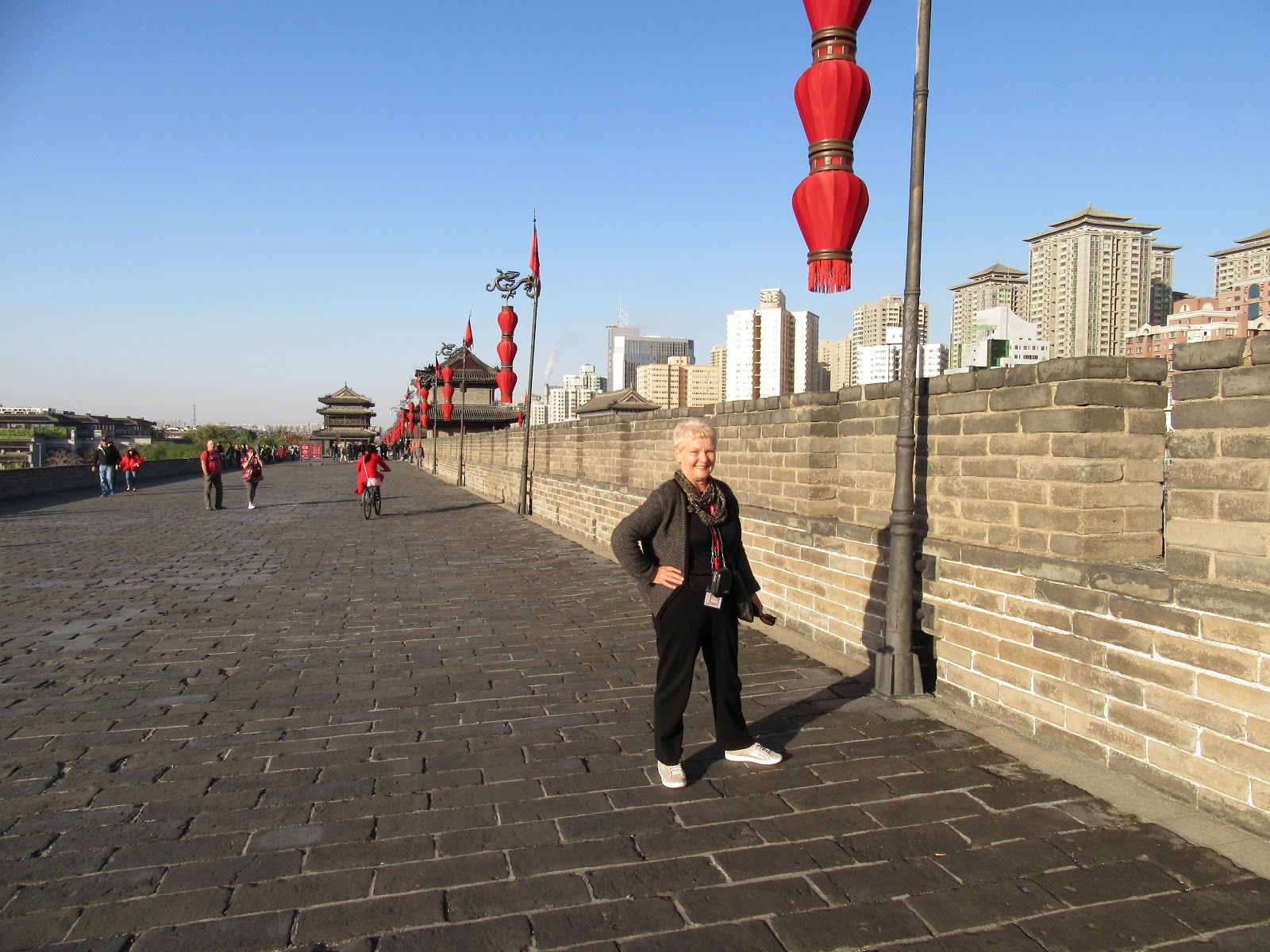
Before checking into our hotel we stopped  to take a stroll on the city wall.  Emperor Zhu Yuanzhang, the first emperor of the Ming dynasty, started construction of the wall in 1370. Today, after much restoration, it is the only complete city wall in China. At 8.7miles long (14ks) and 39 - 46 feet (12 -14 metres) wide it stretches around the old heart of the city and, like all city walls built as protection, includes watch towers at regular intervals. In Xi'an they are 120 yards apart, this is because the most an arrow could travel was 60 yards so that all attacks on the wall could be covered by the archers in adjoining towers. I loved strolling the wide wall in the late afternoon sun, taking in the fine views over the moat, city and surrounding parkland and smiling at the explicit public notices. Not surprisingly it is a very popular walking and exercising spot for the locals.

On the Xi'an city wall

In the evening we set out to view the lights of Xi'an and some of the city's feature landmarks and, my goodness, Xi'an dazzles at night.  There are lights everywhere and it is sparkly and beautiful.  Every lamp post in the city centre is adorned with red lanterns and the city wall and many buildings are outlined in lights.  But nothing can compare with the iconic bell tower at the very heart of the city, it's illuminations turn it into a veritable jewel. Built in 1384 during the Ming Dynasty, for the purpose of broadcasting news, it is reputed to be the largest and best preserved bell tower in China and has become the symbol of the city.  Standing at  130ft (40metres) tall at the convergence of 4 major streets it is a spectacular focal point.


The ancient, beautifully lit  Xi'an bell tower

A highlight for me was stopping to watch the locals dance on a wide pavement outside a shopping area.  Since the Chinese live in tiny apartments they like to get together in any suitable space to exercise. I was transfixed by the group performing an umbrella and scarf dance.  Many were still dressed in their work clothes so had clearly just stopped off on their way home.  Led by a large self-important looking man with a whistle they performed their routines totally unselfconsciously.  This was their normal, it was not put on for tourists.  Beside this group was another group performing a more prosaic exercise class.  I joined in with them briefly and loved it.  I could have spent the evening there, just having fun with the locals in such a happy atmosphere.

(you can see the video of the locals exercising here)


Our final destination that evening was to visit  Hancheng Lake and Park to view a colossal statue of Wu Di, the emperor who reigned for 54
years during the Han dynasty (206BC - 24AD) and a great hero for the Chinese. The evening was crisp and frosty, nevertheless it was very pleasant to walk through the almost deserted park in the darkness with lights shimmering on the water.  Despite the fact that the statue is 70ft (21.5metres) tall, and is accompanied by a full sized chariot and attending warriors, I felt a little underwhelmed.  Yes, it is massive, yes, I should have been astonished but this is a new statue built as part of a Han Dynasty theme park and to me it felt that way. I was much more interested in the locals ballroom dancing in a square off to the side of the park.


Unusual tap suspended from the
ceiling in my hotel room


So that was our first day in Xi'an.  I liked the city and I liked the Buffo Hotel where we were staying.  It is incredibly chic with all sorts of extra details such as electric curtains and windows which can turn from clear to opaque at the touch of a button, however everyone reported a design flaw in the showers which despite all best efforts flooded our bathroom floors. I was a little disconcerted to get out of the lift on the wrong floor  one time and find myself in a fully equipped hospital with nurses in uniform scurrying about.  Handy if you get sick on holiday I guess. 

My next post will be about the phenomenal Terracotta Army.