Monday, 11 March 2019

Beijing, China - a fascinating mix of Modern History, Politics and Ancient Grandeur

A thick orange coloured smog greeted us on arrival in Beijing, luckily,  by the next morning, the city was boasting beautiful sunny weather and the clearest of blue skies which remained with us for our whole visit.  It was a pleasant drive from the airport to our hotel  along pretty park like boulevards, the result of the controversial demolition of many houses, despite residents' protests, in order to beautify the city for the  2008 Olympics.
A smoggy welcome to Beijing
Beijing has a population of around 21.50 million and as the capital city of China is a draw card for millions of tourists from both overseas but mainly from within China.  We were pumped with anticipation, there is a lot to see in this ancient city.


In Tiananmen Square, General Assembly Building behind me
Next morning we set off for Tiananmen Square.  This is where I strongly recommend being part of a tour group.  Since Tiananmen Square is a bucket list place for many Chinese they arrive in their thousands on a daily basis and stand in interminable queues waiting to get in. We, on the other hand, led by our guide clutching pre-booked tickets, sailed past them, oblivious to the scowls and bemused stares of the crowd. 

Built by Mao Zedong, Tiananmen Square is the centre of the General Assembly of China and is said to be one of the largest public squares in the world with a capacity of  more than 1 million people.  To one side of the square is  a large monument to the Peoples' Heroes of the Revolution and Mao's mausoleum, where a never ending queue patiently waits its turn to pay respects. The General Assembly building takes centre stage and on the other side of the square is a massive portrait of Mao.  Prior to our arrival we were warned not to mention anything about the student and workers' uprising of 1989 while in the square or to ask anything about the tanks etc.  Discussion of the military crackdown is prohibited in China and there are plain clothes, secret service agents with English speaking skills located around the square whose job is to listen to conversations and make arrests if necessary.  The Chinese are clearly very twitchy about potential subversion. Actually, the agents were pretty easy to spot as they fiddled with their cell phones and lent on railings but we stayed true to the advice and just drank the whole scene in. 


Monument to the "glorious heroic workers of the revolution"
We were also told that since the square is a place of pilgrimage, which many Chinese save  their whole life to visit,  we would be a curiosity to back country Chinese who had never seen Europeans before.  Our guide even went so far as to suggest they would think we were film stars.  That's as close as I'll ever get to being one! My fair hair  and blue eyes attracted attention and I can't tell you how many photos I am in. It was amusing to notice people surreptitiously posing behind me for a shot with the strange foreigner. We had a good wander around the square, time for a quick group photo and then made our way to the entrance to The Forbidden City, right beside the square.
Inside the Forbidden City. The size of the crowd is an indication of how vast it is.
The Forbidden City, so called because entrance was forbidden to commoners, was built in 1406 and was home to 14 Ming Emperors and 10 Qing Emperors until the last emperor abdicated in 1912 when China became a republic.  Also known as The Palace Museum it is vast, covering 720,000 sq meters (7,750,000 sq feet). It contains 90 palace quarters and courtyards, 980 buildings and at least 8728 rooms. It is known as a masterpiece of Chinese architecture and boasts the worlds largest collection of well preserved wooden, medieval buildings.  
Intricate detailing on the buildings and  tiers of marble balconies.


A view across the city. The buildings on the hill are included.  The large bronze vats were kept filled with water in case of fire.
I found it an intriguing step back in time, imagining the emperors in  glorious robes walking through the vast treeless squares with servants and officials scurrying about them. 


Inside one of the palace rooms, little changed since ancient times.

The walled garden in the Forbidden
City - note the paving between
the trees


I was very taken by the beautiful, painted detailing on the buildings and the elaborate marble railings on the tiered balconies leading up to the palace buildings but, as someone who loves trees and gardens, I thought the vast paved squares with neither tree nor flower a bit soulless. Trees were not planted since they would have been good hiding places for assassins and would also interfere with the squares' primary purpose of holding grand and solemn ceremonies.  However, we did stroll through a walled garden containing large ancient trees within the city complex.  Now a UNESCO World Heritage site the Forbidden City is definitely a "must see".  It's vastness is a bit hard to take in and there is so much room that despite the fact there were many thousands of other visitors there we never felt bustled or as if we were in a crowd.


As with so many grand palaces around the world you can't help but ponder the narcissism and entitlement of those who built them and lived in them but on the other hand you can delight in the extraordinary treasures they have left which many millions of people can now enjoy.  I thought it was amazing and am so glad to have seen it. 

So far it had been a fascinating day with a mix of modern history, politics and ancient, dynastic grandeur.  There was more to come which I will write about in my next post.


Right: She looked so darned cute, I had to get a photo, with her mother's permission.

Wednesday, 13 February 2019

I loved Xi'an, China - It's way more than the Terracotta Army

After our gob smacking experience this morning viewing the Terracotta Army we were feeling pretty content with our day but there was so much more to come.


The Small Wild Goose Pagoda
Firstly we were off to view the Small Wild Goose Pagoda.  It is set  in a lovely tranquil park and with the late afternoon sun dappling the pagoda through the trees it was a lovely place to stroll, relax and spend some reflective time.  The pagoda is itself impressive. Built between 707 and 709 it is 43 metres tall with 15 tiers, the top tier having been crumbled by an earthquake in 1556.  It is said to be one of the most well preserved Tang Dynasty pagodas. The adjoining Jianu Temple originally housed a large Buddha, sadly destroyed in the cultural revolution.


The tranquil park


Right: This large bell is a replica of the original which is 800 years old and is located in the temple. Tourists swing the pole to strike the bell while praying for good fortune.

As part of our tour we were ushered to a nearby calligraphy work shop for a demonstration of the art, the idea clearly being for us to buy.  I don't think anyone did, though, and most of us thought it would have been better to spend more time exploring the pagoda and the surrounding park.


Our next stop was fantastic, albeit not long enough.  We were visiting the Muslim Quarter, a web of streets where the 50,000 Hui Muslims of Xi'an make their home.  Muslims have been part of the population of the city for 1400 years, having arrived in China via the silk road.  I love local markets so was once again in my happy place.  The street of blue stone pavers and shady trees is a vibrant, colourful, exciting corridor of food vendors selling all sorts of interesting food - squid, pomegranates, bread, fruit, pancakes, all types of skewers and candied nuts. Vendors calling out, silver smiths hammering jewelry, nuts being ground and pummeled, lots of people milling around, chatting and eating and as the day turned to dusk, lights coming on, all added to this wonderful joyful, noisy kaleidoscope of liveliness. All the vendors are Chinese Muslim and most wear traditional dress. I loved it and was really sorry we couldn't spend more time there.


But, places to go, food to eat!  We were having a pre show dinner at the Xi'an Chinese Cultural Centre.  Xi'an is proud of its dumplings and, boy, do they put on a display. We were served plate after plate of the tastiest, cutest dumplings I have ever seen. They came out in all shapes - ducks, frogs, hedgehogs, etc., an instagramer's  delight but I was so busy admiring and eating them I forgot to photograph any.


Our final activity for the day was the cultural show, something Xi'an is famous for and a great insight into Chinese theatre. As a tour group we were given VIP seats right up the front so we all had a great view.  The show tells the story of a ruthless, ambitious empress from the Tang Dynasty and draws on traditional Chinese folk dances and music with the whole cast, including the orchestra outfitted in elaborate Tang dynasty costumes.   At one point a chubby man playing the rather shrill Chinese flute  had a solo in centre stage.  He was flamboyant in his performance and looked incredibly proud of himself, you could see him thinking "I am the star of this show".  I'm always interested in cultural performances and found this fascinating, if a little over the top, but I think that is the typical dramatics of Chinese theatre.  I was so exhausted after this big exciting day that I found it hard to stay awake through the performance despite the noise and colour.  (Below is a tiny snippet from the show )


Back at the hotel I fell into bed with a happy smile on my face.  What a great day, and then I reflected on yesterday as well - walking the city wall, the night illuminations,  dancing with the locals in the street and I decided, yes, I have loved Xi'an.

Thursday, 31 January 2019

Terracotta Army - Xi'an, China - A Wonder of the World

 We were all pretty excited to be heading off this morning to see the extraordinary Terracotta Army, a major highlight of our trip to China. The Terracotta Army is an astonishing example of funerary art created  between  246-209 BC  by order of Qin Shi Huang, the first emperor of China, who was just 13 at that time.  More than 700,000 workers worked on the army designed to protect the Emperor in the after life.

Ornate Chinese furniture
Of course, there was the obligatory commercial stop before reaching our destination but  the demonstration at the factory, which produces good quality replicas of the army, was interesting none the less.  We spent more time than we wanted to in the adjoining shop and were all itching to get going to view the actual army but I was rather pleased with the model of a general I bought and admit I was fascinated by the extremely ornate furniture for sale in the furniture gallery.

At last we were off, a short bus ride and then about a 15 minute walk from the parking area to the actual pits to view the army. I enjoyed the walk on this clear sunny day, a row of misty mountains forming a romantic backdrop to the site. Being part of a tour group has both advantages and disadvantages.  You are obliged to visit commercial enterprises that don't really interest you but you also have immediate and preferential access to places of interest. We were through the gates in no time accompanied by a local guide who gave us an interesting talk about  the history, origins and discovery of the army, prior to us entering Pit 1


The vast Pit 1. Restored warriors in front, shattered warriors behind.  
It is hard to put into words what an incredible sight Pit 1 is.  To put it into some sort of perspective it is 230 metres (750ft) long by 62 metres (203ft) wide and contains more than 6000 life sized figures in 11 brick paved corridors.  The ceiling, which  would have been beam and post with a woven reed matting over the top, eventually rotted and collapsed  shattering the warriors.  There they lay buried for around 2000 years until some local farmers decided to build a well in 1974 and discovered fragments which led to a massive, and ongoing, archaeological dig.  No one knew how immense the site would be and in fact ground radar and core sampling suggest that there may be as many as 100 more, as yet uncovered, pits in the surrounding 98 square kilometers (38 square miles) of countryside.


Fragments laid out ready for assembly ....
....and completed warriors.  


All the complete warriors have been painstakingly restored. It is estimated that this site contained 8000 warriors, 130 chariots, 520 horses and 150 cavalry horses.  Most would have been carrying weapons although it appears many weapons were  looted at or soon after their creation. Even so around 40,000 bronze items of weaponry, such as swords, daggers, spears and arrow heads have been discovered in and around the pits.
How the pits appeared when uncovered. A jumble of parts caused by the collapsing roof.
The army was originally painted with
vibrant lacquer like this.  It must
have been an amazing sight

(Photo by Mary Harrsch)
The figures were modeled in parts and then assembled.  Hands, arms and heads were made in molds with the final details hand carved later. There are distinctly different faces on the soldiers who wear uniforms and hairstyles particular to their rank with generals being larger in size. Originally painted in bright lacquer it was found that the lacquer dissolved quickly with exposure to air leading archaeologists to believe the pits may have been hermetically sealed.

Pit 1 is  a vast and extraordinary sight but the other much smaller pits, 2 and 3, are no less interesting.  Pit 2 is considered to be the most complete discovered so far as it contains infantries, cavalries, charioteers and archers.  It covers 6000 square metres (7176 sq yards) with only approx one sixth of it excavated so far. The building housing Pit 2 also contains an exhibition hall where you can view  some of the  warriors and two spectacular bronze chariots close up.
Newly restored and partly restored warriors  and horses in Pit 1
Pit 3 is the smallest of the three pits at 17.6 metres long (19.2 yards) and 21.4 metres (23.4 yards) wide.  Because of the positions of the warriors it is believed to be the command centre for the army. Gold and bronze decorations and a distinctive chariot and four horses were also discovered in this pit.

I was absolutely thrilled to view the Terracotta Army. It is, to my mind, one of the wonders of the ancient world.  Although it has UNESCO protection it amazes me that it does not feature on lists of wonders of the world.  I have always believed that we should not try to put our 21st century brain into the head of a person from earlier times to try and second guess their thinking.  Was the creation of the army unbelievable narcissism, or was it something else?  I guess we will never know.  It did get me thinking, though, that if this was discovered as recently as 1974, quite by chance, what else is there as yet undiscovered in the world.  Who knows? 

Thursday, 17 January 2019

Xian, China - an ancient city of lights

I have a confession to make.  Before booking this trip to China I had never heard of  the city of Xi'an, or if I had it hadn't registered. A bit embarrassing really since not only  is it  the capital city of Shaanxi province, but it also has a very long and fascinating history, is the eastern end of the fabled silk road and  the location of the pits containing the famous Terracotta Army, a sight high on my bucket list.  Xi'an is one of the oldest cities in China. Lantian Man, dating from at least 500,000 years ago, was discovered near the city and so were Neolithic settlements from up to to 6700 years ago. Well, you are never too old to learn and one of the things I find most rewarding about travel is discovering and learning abut new places.

Our arrival in the city was greeted by blue skies and a clear sunny day and my first impression was that it was more traditionally Chinese than the cosmopolitan Shanghai we had just left.  There were many more bicycles and motor scooters on the roads, for a start, and plenty of interesting street life. Xian is a city of 9 million people and although it is ancient the many new, towering apartment blocks give it a fresh look.


View of apartment blocks from my hotel room.  You would need to be sure of your address, wouldn't you?


No words needed - the message is clear!
Before checking into our hotel we stopped  to take a stroll on the city wall.  Emperor Zhu Yuanzhang, the first emperor of the Ming dynasty, started construction of the wall in 1370. Today, after much restoration, it is the only complete city wall in China. At 8.7miles long (14ks) and 39 - 46 feet (12 -14 metres) wide it stretches around the old heart of the city and, like all city walls built as protection, includes watch towers at regular intervals. In Xi'an they are 120 yards apart, this is because the most an arrow could travel was 60 yards so that all attacks on the wall could be covered by the archers in adjoining towers. I loved strolling the wide wall in the late afternoon sun, taking in the fine views over the moat, city and surrounding parkland and smiling at the explicit public notices. Not surprisingly it is a very popular walking and exercising spot for the locals.

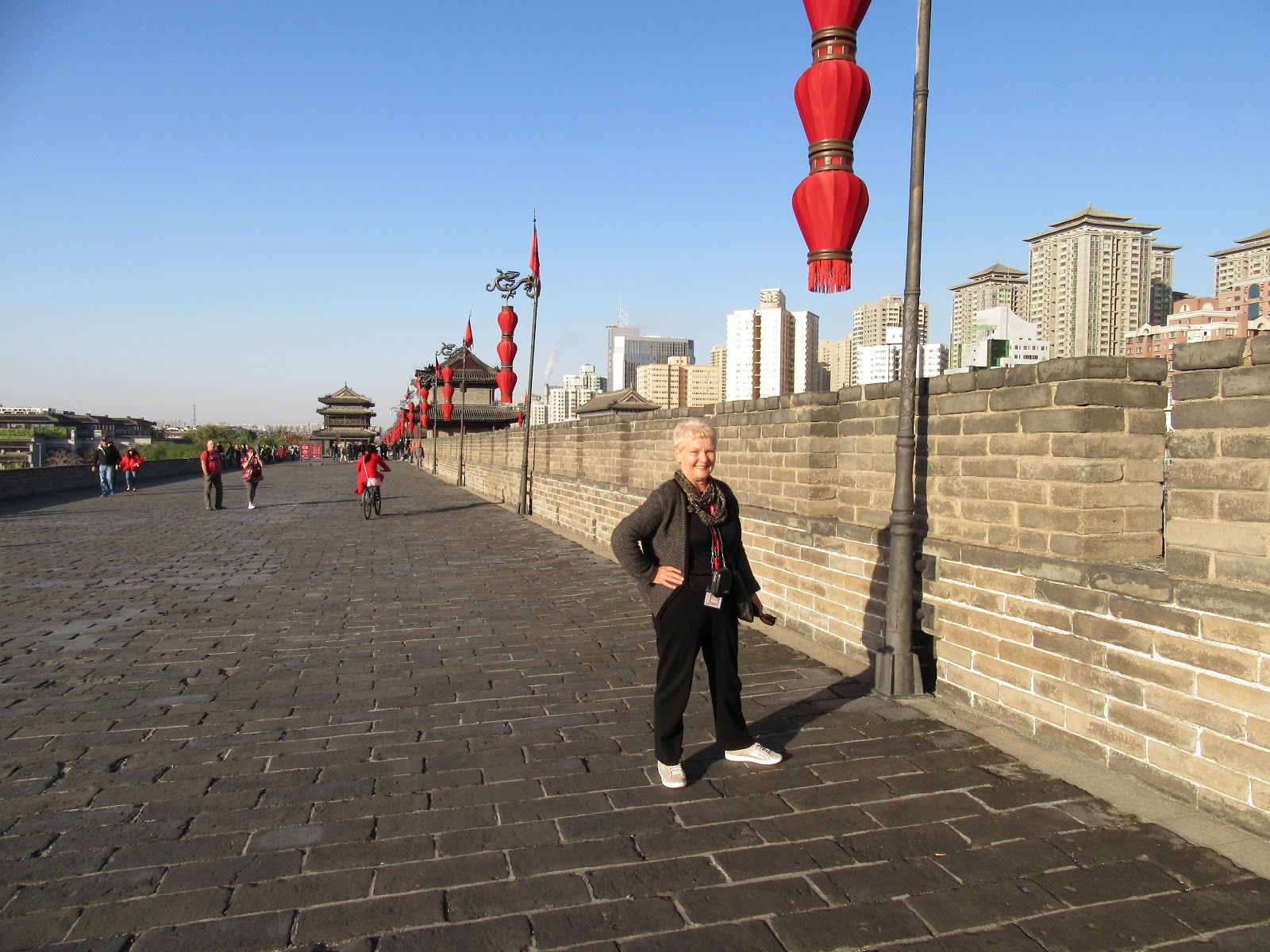
On the Xi'an city wall

In the evening we set out to view the lights of Xi'an and some of the city's feature landmarks and, my goodness, Xi'an dazzles at night.  There are lights everywhere and it is sparkly and beautiful.  Every lamp post in the city centre is adorned with red lanterns and the city wall and many buildings are outlined in lights.  But nothing can compare with the iconic bell tower at the very heart of the city, it's illuminations turn it into a veritable jewel. Built in 1384 during the Ming Dynasty, for the purpose of broadcasting news, it is reputed to be the largest and best preserved bell tower in China and has become the symbol of the city.  Standing at  130ft (40metres) tall at the convergence of 4 major streets it is a spectacular focal point.


The ancient, beautifully lit  Xi'an bell tower

A highlight for me was stopping to watch the locals dance on a wide pavement outside a shopping area.  Since the Chinese live in tiny apartments they like to get together in any suitable space to exercise. I was transfixed by the group performing an umbrella and scarf dance.  Many were still dressed in their work clothes so had clearly just stopped off on their way home.  Led by a large self-important looking man with a whistle they performed their routines totally unselfconsciously.  This was their normal, it was not put on for tourists.  Beside this group was another group performing a more prosaic exercise class.  I joined in with them briefly and loved it.  I could have spent the evening there, just having fun with the locals in such a happy atmosphere.

(you can see the video of the locals exercising here)


Our final destination that evening was to visit  Hancheng Lake and Park to view a colossal statue of Wu Di, the emperor who reigned for 54
years during the Han dynasty (206BC - 24AD) and a great hero for the Chinese. The evening was crisp and frosty, nevertheless it was very pleasant to walk through the almost deserted park in the darkness with lights shimmering on the water.  Despite the fact that the statue is 70ft (21.5metres) tall, and is accompanied by a full sized chariot and attending warriors, I felt a little underwhelmed.  Yes, it is massive, yes, I should have been astonished but this is a new statue built as part of a Han Dynasty theme park and to me it felt that way. I was much more interested in the locals ballroom dancing in a square off to the side of the park.


Unusual tap suspended from the
ceiling in my hotel room


So that was our first day in Xi'an.  I liked the city and I liked the Buffo Hotel where we were staying.  It is incredibly chic with all sorts of extra details such as electric curtains and windows which can turn from clear to opaque at the touch of a button, however everyone reported a design flaw in the showers which despite all best efforts flooded our bathroom floors. I was a little disconcerted to get out of the lift on the wrong floor  one time and find myself in a fully equipped hospital with nurses in uniform scurrying about.  Handy if you get sick on holiday I guess. 

My next post will be about the phenomenal Terracotta Army.

Sunday, 16 December 2018

Shanghai, Day 2 - Silk, Precious Antiquities and "The Venice of the East"

There is nothing quite as luxurious as the soft, slinky, sensuous feel of silk and today we were off to a silk factory to learn about the history and production of this sublime thread. According to Chinese legend silk thread was discovered by accident in the 27th century BC when the Empress, Hsi Ling Shi, (Leizu) was sitting under a mulberry tree sipping tea when a silk cocoon fell into her tea and started to unravel.  She was fascinated by its silky thread so set about  developing a technique for spinning and weaving it into fabric.  Initially reserved for royalty, silk's fame gradually spread through Asia and it wasn't long before demand for silk led to the trade known as The Silk Road - at that time silk was considered to be more precious than gold. Over the centuries silk has become more affordable and accessible  and is now produced in many countries, however, China is still the major producer, cornering nearly two thirds of the market.


The labour intensive job of unraveling the silk
cocoon to remove the worm
Our tour of this modern day silk factory was fascinating and enlightening.  While machinery spins the yarn to make silk fabric,  many parts of the production are manual and labour intensive starting with the removal of the silk worm from it's cocoon, something that can only be done by hand. This requires having your hands in cold water for most of the day summer and winter. It is hard work for low pay so not surprising that no young people want to take on the job.  After watching the whole process of silk production we were invited to help stretch a small square cocoon of silk to the size of a quilt. It took some effort but we got there and were surprised at just how strong silk is.   The factory showroom was an Aladdin's cave of exquisite silk products and many of our group bought items, at very reason prices, at the end of the tour.

Stretching a small silk cocoon to the size of a duvet


Spectacular floral display, People's Square


Before lunch we visited People's Square, central Shanghai,  to admire the spectacular plantings and enjoy the peaceful ambiance of the surrounding park. It is a popular spot for locals to perform Tai Chi or dance but was quiet when we were there in the middle of the day.

The square is the location of the Shanghai Museum, our destination for the afternoon.  Set in a stunning building designed to look like a ding, an ancient Chinese cooking vessel,  the museum, set over four levels, contains a comprehensive collection of Chinese art, ceramics, sculpture, furniture, jade, coins, calligraphy etc.  I love Chinese porcelain so particularly enjoyed that gallery. I was also fascinated by the elaborate, antique furniture in the furniture gallery and the display of traditional costumes from various parts of China.  It is an excellent museum, considered to be one of the best in China, and the perfect place to look at and learn about rare and precious Chinese antiquities.


Exquisite porcelain and national costumes at The Shanghai Museum


Late in the day we drove 50kms out of the city to visit Zhujiajiao, one of Shanghai's ancient water towns.  The village, home to only 300 families, is 1700 years old with many of its buildings dating from the Qing and Ming periods. 

Known as "The Venice of the East" it is a charming place, with weeping willows arching over the ancient trade canals and old houses nestled together along the alleys and canal banks.  It is like walking into one of those romantic paintings of old China. Unfortunately, its beauty has led to a massive influx of tourists, ourselves included!  


"Venice of the East", Zhujiajiao


When we arrived the village was crowded but nevertheless pleasant enough to stroll beside the canals, up and down the narrow alley ways and over some of the village's 36 stone, humped back bridges.  Our group was a pretty adventurous lot so managed to get off the main tourist paths at times and find quiet little corners to enjoy the beauty and tranquility of the place. In order to retain its character residents may alter the interior of their homes as much as they like but cannot alter the exterior.  Most of the lower floors of the two storey houses are given over to shops, food stalls and restaurants, selling everything from roasted scorpions and spiders, to more palatable, to my mind anyway, roast pork wrapped in leaves and duck.  As the day turned to dusk the town emptied out until it seemed there was just our group and the villagers left.  It was so peaceful beside the canals  as the sun dipped below the trees and the lanterns gradually come on,  their light shimmering in the water. We had dinner in the village followed by a very dreamy, step-back-in-time, canal side walk through this ancient village and back to our bus.


Zhujiajiao by night

What a great day, with plenty of time to reflect on what we had seen during the bus ride back to the hotel. 

Two more views of Zhujiajiao


Here are some things of note about Shanghai:


*Shanghai is China's most populated city with 25m residents

*The streets are very clean and there is no graffiti anywhere
*Billboards and advertising hoardings are relatively rare
*All the major roads around the city are adorned with colourful baskets of
Apartment buildings trimmed with lights
flowers attached to the safety railings
*Spectacular floral displays around the city are constructed from hundreds of   very small pot  plants
*It's smoggy but not every day
*They love lights, even  apartment buildings are elaborately decorated with lights
* And despite being officially an atheist country there were Christmas decorations  everywhere!

I really enjoyed Shanghai and would happily return at some stage but we were off to our next destination, Xian.


Wednesday, 5 December 2018

Shanghai, China, The Paris of the East, Day 1

 It has been 25 years since my husband and I visited Hong Kong and China so I thought it was about time I went and had another look. I was interested to see how much China had changed in the years since.  In 1993 we were aware that the UK would soon be returning the governance of Hong Kong to China and we wanted to see it before then because we were unsure of what its future would hold. 
In a Cantonese Village 1993
  China had only started to emerge from its self imposed isolation in 1978 and we were keen to see life there before the overwhelming influences of the outside world took hold.  At that time the streets were still thick with bicycles, millions and millions of bicycles, many people still wore  grey or navy blue Mao suits and my husband and I, both blue eyed blondes, were often trailed down the street by a crowd of people staring curiously at the weird foreigners. 


Canton 1993 - Mao suits and carrying baskets
That tour took us through the district of Canton, the closest part of China to Hong Kong, and although we traveled on a relatively modern bus the roads were so primitive and pot holed that, on one occasion, it took us a whole day to travel 40 miles. 


Chinese road workers in 1993. Their only tools, a pick, a shovel and old style wheelbarrows. Note they are wearing sandals.   No wonder the roads were bad.
It was a great trip and I was so pleased to have seen China at that point in its history. As it happened I returned to Hong Kong several times for work and found nothing much had changed after the hand over in 1997, it was still busy, buzzy, capitalist and exciting.

This year I wanted to see the changes in China, also to visit some of its iconic sights and tick them off my bucket list so  I joined a Wendy Wu tour which took me to three great cities, Shanghai, Xian and Beijing.

Joining a tour group is always interesting. You are a group of strangers thrown together to spend a lot of time sharing the same experiences. Our group numbered 29 and I can't believe how lucky we were to have such a great crew. Everyone got on well, everyone was interested and interesting and although subgroups of like minded people formed we were altogether a happy, harmonious group. 


Our Wendy Wu Tour Group at the City Square, Shanghai

TIP FOR SOLO TRAVELERS: take the plunge and join a tour group.   You will not feel like a loose wheel, there are always other singles and, in fact, our group consisted of 19 singles and only 5 couples.  It makes sightseeing fun to have others to share it with.

For some reason I had always wanted to visit Shanghai, I guess because it has featured in several novels I have read and carries an air of romance about it. It was the least Chinese of the cities we visited and, I would venture, probably the least Chinese of China.  As the country's financial centre it is a modern, cosmopolitan, affluent city with a population of around 25 million, also home to the worlds busiest container port. The British and French influences from the past are evident in the grand banks and hotels lining The Bund  so it is easy to imagine you are in Paris or London or any number of other European cities, in fact Shanghai is often referred to as "The Paris of the East". Turn around and look across the River Huangpu, though, and you are met with an astonishingly futuristic skyline.


Elegant buildings line The Bund

But first we were immersed in old world Shanghai during a visit to the magnificent Yu Garden.  Built in 1559  for the commissioner of Sichuan Province the garden covers two hectares and is a fine example of Chinese classical garden architecture, containing all the key features of a Chinese garden: stone, water, trees and architecture.  This is my kind of thing. I could have happily spent hours there although preferably when there were about 90% fewer people! It wasn't exactly tranquil. Outside the garden the modern world erupts with a Starbucks and a KFC prominently positioned in the very crowded adjoining square.


In the Yu Garden.  I managed some shots without the crowds!


Lunch was on a floating restaurant in the river overlooking a constantly changing view of  barges and river boats ferrying containers up from the port. Then we were off to the Shanghai Tower, one of three massive skyscrapers built in a cluster. The high speed elevator takes just 45 ear popping seconds to reach the 88th floor and then you are rewarded with an expansive view over the city, or you would be if the smog wasn't quite so dense. The most dramatic part was leaning over a light shaft through the centre of the building to view the lobby of the Grand Hyatt hotel 127metres below, not for the faint hearted!


Left: Shanghai from the Shanghai Tower.  It's a wee bit smoggy!


Right: looking down into the Grand Hyatt Lobby


Would we like a ride on the world's fastest train?  Would we ever! So next stop was the Maglev.  Driverless and computer controlled the train levitates above the track on powerful magnets. It reaches a top speed of 431 ks per hour and takes just 7 minutes 20 seconds to cover the 30kms to the airport, a journey that takes buses an hour.  It was a thrilling, exciting ride out to the airport and back. Two elderly American men sitting behind me spent the whole trip whooping with delight.

All this excitement!  It was time to calm down a little and take a gentle stroll along The Bund including a visit to the former HSBC Bank.  They don't build banks like that anymore!  Mosaic ceilings, marble pillars, gigantic lobbies, grandeur at every turn. The jaw dropping building is still a bank although no longer the HSBC.


   Marble pillars and mosaic ceilings


As the day turned to twilight we meandered leisurely, enjoying the scenery, the lights gradually coming on up and down the river and the crowds of locals enjoying a walk after work. I was fascinated by the elaborate walls of pot plants along the river bank making the perfect backdrop for wedding  couples having their photos taken.
This colourful wall is made up of very small individual pot plants

Our final activity for the day was a cruise on a river boat to view the magically lit waterfront of Shanghai.  It was the perfect end to a fantastic day of sightseeing. And tomorrow was another day.

You can view the cruise here:          (music - Dreaming by Wai Fat Chun)