Sunday, 4 September 2016

The Hive - Kew Gardens' stunning new attraction

There is never really any need for an excuse to visit Kew Gardens, London, or to give it it's correct title The Royal Botanic Gardens, Kew.  Every season brings a new delight and a new perspective to this incredible showcase for the world's plants. A Unesco World Heritage site, Kew is home to 30,000 different living plants and 7 million preserved specimens of different kinds of plants.  It is a botanist's dream but more than that it is simply a beautiful serene, verdant park to stroll and picnic and enjoy being at one with nature.
Flower beds form only a small part of Kew gardens
I have visited Kew many times, as it is conveniently close to my son's home, and always find something new to enjoy.  On my last visit I had relished the climb up to be among the trees on the treetop walkway.  This time I was completely entranced by The Hive.

The Hive is a sculpture by Wolfgang Buttress, built as the centrepiece of the UK pavilion at the Milan Expo in 2015. It has been reassembled at Kew where it will remain for just 18 months so I suggest you get along  to see it smartly.  It is incredible.
Like bees buzzing around a hive
17 metres high, suspended above the ground and made up of 170,000 pieces of aluminium , the inspiration behind the sculpture is the role and plight of honeybees which, although they play an essential role in pollinating most of our food crops, are becoming increasingly endangered. From a distance the sculpture looks like swarming honey bees but as you get closer it takes on the appearance of a hive. As you walk towards The Hive you pass through a one acre flower garden planted with all types of wild flowers particularly attractive to bees, their buzzing helps set the scene for your experience of The Hive.


The path takes you right inside The Hive which is connected to accelerometers, or vibration sensors within a real beehive elsewhere in Kew Gardens. These pick up the activity of the bees and are then transmitted to The Hive where they are converted to lighting and sound effects as a representation of the activity in a bee colony. 

Inside The Hive
 The haunting and atmospheric sound track, the work of the band Spritualized, is a combination of recordings of a 40,000 strong bee colony plus instruments and the human voice while 1000 LED lights flicker and glow to show the movements of bees in and out of the real hive. 
Lights go on and off to reflect the movements of the bees in the real hive nearby
 Wolfgang Buttress said that "My approach to a sculpture seeks to frame nature so one can experience it more intimately" He has certainly achieved that goal.  I found the whole experience to be quite wonderful and completely mesmerising, worth visiting Kew Gardens for this alone.

The Orangery, a great spot for people watching.
But, do enjoy the whole of Kew Gardens, there is so much to see.  I rounded out a happy day with lunch at the Orangery and a quick browse in the excellent gift shop. I know I'll be back.

www.kew.org


Monday, 29 August 2016

Find big cities impersonal? Visit Radnor Gardens Cafe in London for that warm community feel.

Big cities can seem overwhelming to those of us who live in smaller, quieter places but I realised many years ago that they are in fact just a collection of villages joined together.  The first time this occurred to me was when I was in Tokyo staying at a multi storied youth hostel.  In the evenings I liked to wander up a side street and it didn't take long before I noticed that the locals knew each other, that eateries were crammed with family groups sharing conversations across tables and that shop keepers were gossiping with regulars, all in central Tokyo.  I loved it and since then no big city has been intimidating to me...I just break it down and get to know and enjoy each locality.  Of course central business districts are generally soulless places but get out into the residential areas and things change, even close to the city centre.

Have coffee while you watch your children play

The delightful Radnor Gardens Cafe at Strawberry Hill, Twickenham in London is a prime example of "community" in a big city. Owners, Mike and Marcus took the lease on a council owned cabin in the park back in March this year.  Their aim was to create a friendly cafe where locals could meet, have coffee, or a meal, and a chat and get to know each other. It is not a glitzy, chrome and glass type of place and that is part of its charm. In order to create a welcoming, homely, environment fresh flowers are placed on the tables each day and various games and a table tennis table are available to patrons. Warm shoulder wraps are also provided for cooler days. The cafe is adjacent to a safe fully fenced children's playground allowing harassed parents a sit down and a cup of coffee while still keeping an eye on their offspring. Mike and Marcus have obtained a license to serve wine and beer for a certain number of  days in summer so have run a series of barbecues on long summer evenings.  My son and his family live across the road and told me what a pleasure it was to meet with neighbours at one of these evenings and to have somebody else cook the food and pour the drinks! 

On my recent trip to England I enjoyed many a time at the cafe even a delicious bacon sandwich for breakfast on my last day. It was so pleasant sitting in the sun, chatting to locals passing by or stopping to have coffee. I had a long chat to Mike one day.  He told me that he has been delighted with the positive response from locals, that he thinks people really want an opportunity to connect and that he is pleased to be providing it. Many, many places have community cafes, my own suburb in Auckland, for example, where people meet neighbours and locals, but what I think makes Radnor Gardens Cafe special is its location, right inside the park, and the enthusiasm of the owners for fostering a sense of community in the area.   So far it  has been a resounding success, long may it continue, and I look forward to visiting again sometime in the future. Oh, and the coffee is pretty good, which is high praise from a New Zealander!
Anyone for table tennis?
Don't just go to Radnor Gardens for coffee, though.  Take a walk through the gardens, enjoy the lovely views of the Thames riverside, sit under a weeping willow and listen to the wind in it!

Disclaimer:  I do not know the proprietors and the opinions expressed here are simply my own observations.  

UPDATE: The cafe changed hands in 2019 and I have been advised by former regulars that it is no longer the community cafe it was. It is still in the same good location beside the playground, though.
 You are welcome to follow me on Facebook @ A Wandering Widow Solo Travel, I'd love to see you and your comments both here and there!

Monday, 11 July 2016

Easiest Ever Steamed Pudding - just the thing for a cold winter's night

I love the occasional steamed pudding in winter, it is real comfort food.   Unfortunately the long cooking time needed for a traditional steamed pudding, like mother used to make, doesn't fit well into the busy, modern world. Luckily I have a recipe for a quick and easy and delicious one. It is brilliant and a long time favourite of my family.  It uses simple ingredients found in every pantry and can even be put on to cook just as you are serving up the main course.


EASIEST EVER STEAMED PUDDING

Ingredients 

2 tablespoons butter
3 tablespoons golden syrup 
3/4 (three quarters) of a cup of flour
2 teaspoons baking powder
1 tablespoon sugar
1 egg
1/2 (half) cup of water

Put about 3 inches or 6cms of water on to boil, in a pot large enough to hold the pudding basin. Place the butter and golden syrup in the pudding basin and place the basin in the pot to melt the syrup. Into a bowl sift the flour and baking powder, then stir in the sugar.  Break the egg into the mixture and stir around a bit then add the cold water and beat to make a smooth batter.  Pour the batter straight into the melted syrup mix.  There is no need to cover the pudding, simply put the lid on the pot and simmer/steam for 20 minutes. The pudding rises and has a folded look while the syrup and butter flavours the whole pudding.  You can serve it with custard or cream but I never bother. Or you can experiment with different syrups. I think it is yummy just as it is.

I made one especially to photograph for this post, now I'm just going to have to eat it.  Oh goody! Nom, nom, nom....... :-)


Monday, 4 July 2016

Happy July 4th, America!


Thirty years ago today I was lucky enough to be in Boston for the 4th of July celebrations. It was a day I will never forget.  Americans sure are proud of their country and know how to celebrate it. Every street was lined with Stars and Stripes bunting, every public building adorned with flags, every person walking around with a great big smile on their face, parades and festivities all day long. I was with my husband, brother, sister-in-law and nephew and we made the most of the day, from following the Independence Day parade to eating gigantic hot dogs in the park. 

Reading of the Declaration of Independence
The Salute to the Dead Ceremony


 It was a privilege to attend the Salute to the Dead Ceremony at the Civil War Cemetery and to hear the Declaration of Independence read from the exact same balcony it was read from 240 years ago. Americans around us had tears in their eyes at the glorious bass rendition of 'America' sung from the same balcony.  Then, formalities over, it was party time as  Bostonians thronged the streets, strolled happily, sang, danced and picnicked in the park while tourists, like us, lapped it all up.

Yep, that's me, Faneuil Market, Boston July 4th 1986


Much to my husband's embarrassment I bought a statue of liberty headband and wore it all day.  Well, you have to get in the spirit of these things, don't you?
I think my husband was surprised when a newspaper photographer asked to take my photo and by the several offers from strangers to buy the headband off me, at vastly inflated prices I might add!  I kept it, money didn't tempt me, and I still have it today as a souvenir of a truly wonderful memorable day spent with family.  Sadly my brother and husband are no longer here but these memories of a great day with them will always remain.

HAPPY BIRTHDAY, AMERICA AND SPECIAL GOOD WISHES FOR MY AMERICAN FRIENDS!

Monday, 27 June 2016

It's a Celebration - and a thank you!!!


Celebration time!  This is how I feel!  Not my photo but one I love - (copyright free)
  Wow!  I can't believe it!!  My little hobby travel page has now had over 30,000 readers, 30,066 to be precise and  I'm tickled pink.  It is satisfying to know that there are people all around the world reading and finding something of interest on my blog.  A huge thank you to all of you!

When I hit the 10,000 and 20,000 marks I sent a small gift to the person who got me there but this time I was taken by surprise by a web address in Mauritius which made multiple visits today and pushed me well over the mark.

Writing this blog  has kept me motivated to get out and do things in order to have something interesting to write about.  It is also a handy diary of what I've been up to, so it's been a win/win all round. 

Don't hesitate to put remarks - good or bad - in the comments section. I'd also love your feed back on what New Zealand  topics and/or places you would find of interest and then I will aim to please :-) 

 I am off on another international adventure shortly so, hopefully, will have a lot more of interest to write about. I'm getting excited with the very thought of it!

Meanwhile here are my 5 most popular posts:
  • Des Goupillieres - Troglodyte Village - Loire Valley (Featured post)
  • Flavigny Sur Ozerain....and Chocolat
  • Akaroa - New Zealand's only French Village
  • Australia Zoo, Queensland - Home of the Crocodile Hunter
  • Cappadocia - A magical, Ancient Land

Sunday, 19 June 2016

Haiku and Zen poetry

I'm a great fan of Haiku, the Japanese poetry discipline which manages to say a lot in very few words.    The art of Haiku is to establish a thought provoking image, traditionally, but not always, using just seventeen syllables in a 5-7-5 pattern. The idea is to take imagery from nature as a basis for deeper philosophical thought.

Although it is now winter in New Zealand my garden is acting like it is late autumn, the scarlet leaves still gently falling from my maple trees. The leaves give me great pleasure and have inspired me to re-read a few autumnal haiku.


I went straight to the works of the greatest zen poet of all, Matsuo Basho (1644 - 1694) I never fail to be entranced by his succinct word pictures. Originally in training as a samurai, or warrior, Basho abandoned that life to travel around Japan and pursue the life of a wandering poet. His works are widely acclaimed throughout the world. This is his most well known Haiku:


An ancient pond
A frog jumps in
the splash of water

And here are a couple of his autumn themed poems:

An empty road
lonelier than abandonment
this autumn evening 


Won't you come and see loneliness
Just one leaf from the kiri tree 


This poem is by Ryokan (1758 - 1831)

My legacy....
What will it be?
Flowers in spring
The cuckoo in summer
And the crimson maple of autumn


Here is one by Shiko, an artist, engraver and poet (1903 - 1975)

How enviable
Turning beautiful then falling
Maple leaves 


But since it really is winter I think I should add a couple of winter themed haiku.  These two are both by Basho:

 
How admirable
to see lightening and not think
life is fleeting

And:

Winter solitude
in a world of one colour
the sound of the wind


 Every season has it's pleasures and it's downsides, just like life.  The beauty of Haiku is the way it can combine the imagery of nature with the full range of human emotions. Occasionally I like to try my hand at writing them with varying degrees of success, however, I am fond of this one I wrote in memory of my late husband, a keen fisherman:


Waitemata dawn
Golden glow on silver sea
Quietly fishing

All photos are my own.

Tuesday, 7 June 2016

Architecture - The Iconic New Zealand Villa

To most people the word 'villa' conjures up images of white washed or ochre coloured houses in the Mediterranean or around the Caribbean, not in New Zealand, though. Here the Villa is a very distinct and iconic style of architecture, with no resemblance to the villas of the northern hemisphere. 

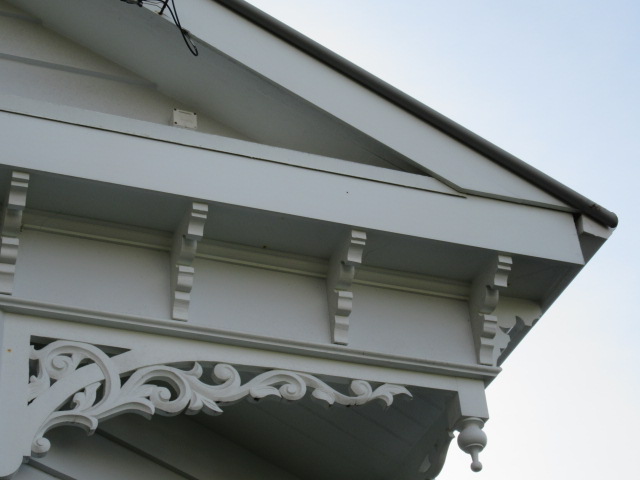
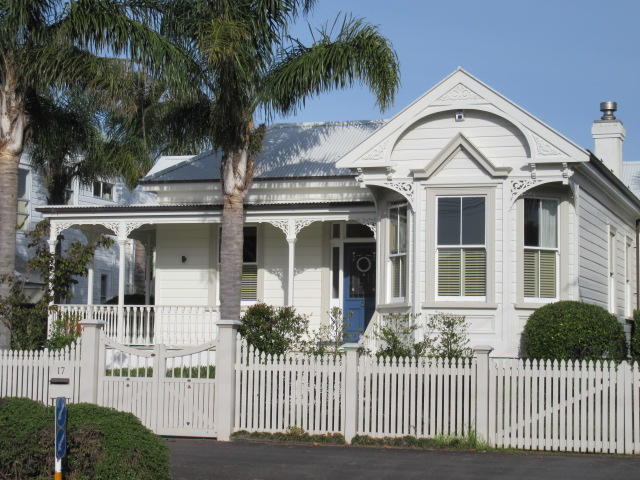
 In the early days of settlement  New Zealand was a largely rural society with  most people living in small cottages. As cities grew and  suburbs developed, people became more affluent and looked for larger and more permanent homes, which the Villa provided. Drawing on Victorian influences the Villa was ornate and decorative having its heyday  between 1880 and up to the start of the first World War when austerity measures were adopted.Villas were built entirely of wood with  metal roofs, and often pre fabricated,  floor plans  were usually chosen from a catalogue. They featured high ceilings, sash windows and wide hallways and decorative features included stained glass windows, lacy fretwork and turned finials on the roof. 


A two storied Villa with all the usual features; finials, ornate fretwork, wrap around verandahs and stained glass
 
They were not built for the sun, with the master bedroom and little used, formal, parlour facing the road regardless, which, together with being  uninsulated, made Villas cold and draughty. Different cities in New Zealand had slightly different styles of villa, for example, in Auckland's warmer climate large wrap around verandahs were a feature, in Wellington Villas tended to be narrower and in Dunedin wrought iron was used as a decorative finish. They did not have running  hot water and in the early days, as was normal for the times, the toilet was a long drop in the garden.  Later the toilet was moved to the main house but was usually located at the end of a back verandah which meant going outside the house and along the verandah whatever the weather, an improvement on having  an outhouse in the garden, at least.


My Grandparents house, a later version - the Transitional Villa.  The only change is the top floor, added by new owners.
I have a particularly warm spot for the Villa, my grandparents lived in one and it is where my mother spent part of her childhood. Typically their Villa had a wide central hallway with the master bedroom one side of the front door and a small parlour, for entertaining guests, on the other side. This part of the hallway was separated from the rest of the house by dark red velvet curtains, no doubt to contain the warmth and prevent draughts.  Beside the master bedroom were two more bedrooms and beside the parlour was a large sitting room with a fireplace.  Next to the sitting room was a kitchen/dining room which was bright and sunny in the afternoon and next to the third bedroom was the bathroom.  The walls of the bathroom were vertical ship lap timber painted green and the bath was free standing and heated by a gas caliphont which gurgled and spluttered and frightened me as a child.  The sunniest rooms in the house were the bedrooms, bathroom and toilet. Also, typically, the toilet was along the outside verandah and the laundry was in a separate outhouse commonly known as the wash house.  There was no running hot water in the kitchen, hot water came from a wall mounted Zip heater, although in later years they did have a hot water system installed. Despite the slightly terrifying caliphont I have nothing but warm happy memories of this house.  My grandmother grew masses of daphne along the side path and I only have to get a slight sniff of daphne to be transported back there, full of happiness and nostalgia.


Today Villas are highly sought after although they need to be extensively altered to suit modern lifestyles. The key to a successful renovation is to retain the exterior (as seen in the photos above) while altering the layout inside.  Villas epitomise the romantic dream of a house a garden and a white picket fence.  At the time they were built cities were very small and villas were out in the new suburbs.  Today, as the cities have grown, those suburbs are mainly central city. Partly because of their central location and partly because they are a beloved style of architecture in New Zealand a well refurbished Villa is now very expensive.

A modernised Villa, adapted  for modern living but retaining many original features. 

Examples of Villas are spread throughout the inner suburbs of Auckland but some suburbs have more than others. Devonport and Cheltenham are two of the best but they can be found in numbers in Herne Bay, Ponsonby, Parnell, Remuera (where my grandparents lived) and Epsom.

All photos are my own